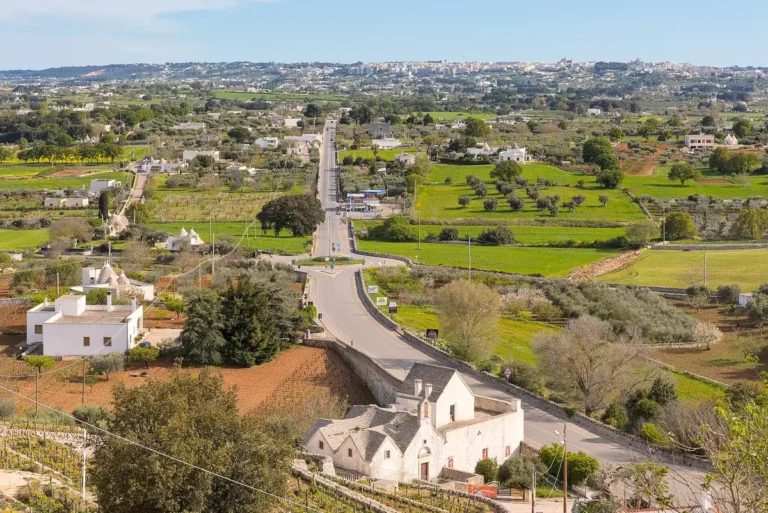

The Valle d’Itria is trulli, dry-stone walls and small white towns a few kilometers apart, which is lovely until someone is unwell at nine on a Saturday night and nobody is sure which town has the hospital. The answer changed in June 2026, when a new hospital opened between Monopoli and Fasano. This guide is for everyone, travelers and locals, adults and children: where to go from Alberobello, Locorotondo, Martina Franca, Cisternino, Ostuni, Ceglie Messapica, Fasano and Monopoli, when to call 112, and how the out-of-hours system works. Children’s services have their own section.
Please note: in an emergency call 112. Hospital services, sites and hours change, so check the linked official pages before you travel. This is general information, not medical advice.
The short version
- Life-threatening emergency: call 112. It is free, multilingual and has covered all of Puglia since May 2024; 118 still works and reaches the same center (Regione Puglia announcement).
- The three ER departments in the valley itself are at Martina Franca, the new Monopoli-Fasano hospital and Ostuni. Martina Franca and Monopoli-Fasano also have children’s wards.
- Alberobello, Locorotondo, Cisternino, Ceglie Messapica and Fasano have no hospital ER of their own, but each is within about 10 to 30 minutes of one.
- Out of hours: the continuità assistenziale (out-of-hours doctor, still widely called the guardia medica) every night and at weekends; for children, the SCAP weekend pediatric clinics.
- Medicines at night or on a Sunday: the farmacia di turno (duty pharmacy).
Hospitals with an emergency department
The valley sits where three provinces meet, so three health authorities share it: ASL Taranto (Martina Franca), ASL Bari (Monopoli, Alberobello, Locorotondo, Putignano) and ASL Brindisi (Ostuni, Fasano, Cisternino, Ceglie Messapica). Their emergency pages list every pronto soccorso and show live counts of patients waiting by triage color: ASL Taranto, ASL Bari and ASL Brindisi. Children’s wards are confirmed in the Regione Puglia list of maternity and children’s units and on the hospitals’ own pages.
| Hospital | Address | ER | For children |
|---|---|---|---|
| Valle d’Itria, Martina Franca | Piazza San Francesco da Paola 1, Martina Franca | Yes | Pediatrics and neonatal ward; SCAP weekend clinic |
| Monopoli-Fasano (new hospital) | Contrada Sant’Antonio d’Ascula, Monopoli | Yes, since 11 June 2026 | Pediatrics and neonatal wards, pediatric outpatient clinic |
| Papa Francesco, Ostuni | Via Villafranca, Ostuni (ER entrance from Via Luigi Miccoli) | Yes | No children’s ward; SCAP weekend clinic |
| Santa Maria degli Angeli, Putignano | Piazza Padre Pio 7, Putignano | Yes | No children’s ward listed |
| Camberlingo, Francavilla Fontana | Via Mons. Armando Franco, Francavilla Fontana | Yes | SCAP weekend clinic |
Martina Franca
The Valle d’Itria hospital stands a few minutes’ walk from Martina Franca’s old town. With Monopoli-Fasano, it is one of the two hospitals in the area with both an ER and a children’s ward (pediatrics with neonatology). It is about 10 minutes from Locorotondo, about 15 from Cisternino and about 20 from Alberobello. ASL Taranto also runs a SCAP here on the days before holidays and on public holidays, from 8:00 to 20:00, for children with minor problems.
The new Monopoli-Fasano hospital
Built in the countryside between Monopoli and Fasano, the new hospital opened its pronto soccorso on 11 June 2026, with separate routes for adults, children and stretcher cases. By 15 June all 12 wards were running, including pediatrics and neonatology, and there is a pediatric outpatient clinic. The ER of the old San Giacomo hospital in Monopoli town closed on 11 June, so older maps, apps and holiday-rental guides may still send you to the wrong place. It is about 10 minutes from Fasano, about 15 from Monopoli and about 25 from Alberobello, Locorotondo or Cisternino. After the opening, ASL Bari and ASL Brindisi agreed that 118 ambulances from the Fasano and Cisternino areas can also bring patients here.
The old San Giacomo building on Largo Veneziani is becoming a community health center. The guardia medica and the SCAP weekend pediatric clinic have stayed there during the works.
Ostuni
Ostuni’s hospital, Papa Francesco, has an ER but no children’s ward, so a child who needs to stay in will be moved to a hospital that has one. ASL Brindisi runs a SCAP here on Saturdays, the days before holidays, Sundays and holidays, from 8:00 to 20:00. From Ceglie Messapica the drive is about 20 minutes, the same as to Francavilla Fontana.
Putignano and Alberobello
Alberobello has no hospital. The nearest ER is at Putignano, about 15 to 20 minutes away, which has no children’s ward listed. For a child, Martina Franca (about 20 minutes) or Monopoli-Fasano (about 25) is often the more useful choice, since both can admit children.
The larger hospitals the valley relies on
For serious illness, surgery or intensive care, patients from the valley are referred or transferred to one of the big regional hospitals. You would rarely drive to these on your own in an emergency, but it helps to know the names.
| Hospital | Address | For children | Approx. drive |
|---|---|---|---|
| Giovanni XXIII, Bari | Via Giovanni Amendola 207, Bari | Puglia’s children’s hospital, with its own pediatric ER | About 40 min from Monopoli, 50 from Fasano, 1 hour from Alberobello, 1 hour 10 from Martina Franca |
| Perrino, Brindisi | S.S. 7 per Mesagne, Brindisi | Pediatrics ward, neonatal intensive care | About 40 min from Ostuni |
| SS. Annunziata, Taranto | Via Bruno 1, Taranto | Pediatrics ward, neonatal intensive care | About 40 min from Martina Franca |
| San Pio, Castellaneta | Via del Mercato 1, Castellaneta | Pediatrics and neonatal ward | About 55 min from Alberobello, 1 hour from Martina Franca |
Heading further south? Our guide to hospitals and emergency care in Salento covers Lecce and the rest of the province.
When to call 112, and when to drive
Call 112 (or 118) straight away whenever a life may be at risk. The national 118 guidance lists breathing that is difficult or has stopped, chest pain, a person who has lost consciousness and does not respond, injuries with heavy bleeding, any serious accident (on the road, at home, at sea or during sport), sudden difficulty speaking or weakness in the arm and leg on one side, and signs of choking, poisoning, drowning or burns.
For a suspected stroke, the Ministry of Health uses the FAST check: a face that droops on one side, an arm that cannot be raised or held up, speech that is slurred or strange, and time, meaning call 112 or 118 at once. Do not wait to see whether it passes, do not call the out-of-hours doctor and do not drive yourself, because the ambulance will go to a hospital with a stroke unit.
With children, also call 112 if a child turns blue or gray, is unusually floppy, has a seizure, a serious head injury or has swallowed something dangerous. The same goes for a severe allergic reaction in anyone. The operator locates you and passes the call to the 118 medical service, which decides which hospital is right.
For worrying but stable problems, such as a high temperature in someone who is alert, a sprain or a cut that needs stitches, drive to the nearest ER (for a child, ideally one with a children’s ward). Arriving by ambulance does not get you seen sooner.
What the operator will ask
Stay calm and answer the questions. The 118 guidance asks callers to give their phone number, the place (town, street and house number), what happened, how many people are involved, and whether they are responding, breathing or bleeding. Mention a young child, a pregnancy, an older person or a known condition such as heart disease, asthma, diabetes or epilepsy. Stay on the line until you are told you can hang up, then keep the phone free in case the operations center calls back.
In the countryside between the towns, where many visitors stay in masserie (farmhouses) and trulli, a dropped pin or the name of the contrada (rural district) helps the crew find you.
How triage works
A triage nurse assesses every patient at the door and assigns a code, and you are seen in order of urgency. Puglia uses the national five-code scale, which appears in the regional ER figures.
| Code | Color | Meaning |
|---|---|---|
| 1 | Red | Emergency, seen immediately |
| 2 | Orange | Urgent, seen very quickly |
| 3 | Azure (light blue) | Urgent but can wait a little |
| 4 | Green | Minor, low priority |
| 5 | White | Not urgent |
Some ASL pages still describe the older four-color scale, so do not be surprised by either. White-code visits carry a ticket (patient charge), and that kind of problem is usually better handled by the continuità assistenziale or, for a child at the weekend, the SCAP.
Out of hours
Continuità assistenziale (the old guardia medica)
The continuità assistenziale (out-of-hours medical service), still widely called the guardia medica, is the local out-of-hours doctor for problems that cannot wait for the family doctor. It runs every night from 20:00 to 8:00, and during the day on Saturdays, the days before holidays and holidays; the exact daytime hours vary a little between ASLs. You phone first or go to the local site, and the doctor advises, sees you or visits.
Year-round sites in the valley include Alberobello (Viale Margherita 30), Fasano (Via Nazionale dei Trulli 95/A), Cisternino (Via Regina Margherita 80), Ostuni (Via Miccoli) and Ceglie Messapica (Largo Cappuccini, in the former hospital). Full lists and phone numbers: ASL Bari, ASL Brindisi and ASL Taranto.
The service is free for residents of Puglia. Visitors from outside the region pay the doctor directly: ASL Taranto’s page, citing the regional agreement, gives €15 for a clinic visit and €25 for a home visit, with a receipt.
Guardia medica turistica (summer tourist doctor)
In summer some ASLs add clinics for visitors. ASL Bari’s page describes its visitor service as running from 1 July to 31 August, on weekdays from 10:00 to 20:00, at a handful of sites. ASL Brindisi and ASL Taranto announce any summer arrangements on their news and guardia medica pages. The sites change from year to year with staffing, and the 2026 season has ended, so check the ASL pages again next June rather than relying on an old list.
116117, the new non-emergency number
116117 is the European number for non-urgent medical care. The Ministry of Health authorized Puglia to launch it on a trial basis in August 2026, and the region said the first phase, due this autumn, would replace the separate continuità assistenziale numbers, answer 24 hours a day and pass any emergency on to 118 (Regione Puglia announcement). It cannot be called from a locked phone. When we checked in mid-October 2026 we could not confirm that it was live everywhere, so if 116117 does not connect, use the numbers on the ASL pages. It never replaces 112 or 118.
If the patient is a child
Children use the same pronto soccorso as adults. In and around the valley, Martina Franca and Monopoli-Fasano are the two hospitals that can also admit children, and Puglia’s children’s hospital in Bari is listed in the table of larger hospitals above.
SCAP: pediatricians at the weekend
The SCAP (Servizio di Consulenza Ambulatoriale Pediatrica) puts family pediatricians in a clinic by the hospital, free and without an appointment, for children with minor problems. In and around the valley there are SCAP clinics at Martina Franca, Ostuni, Francavilla Fontana and the former San Giacomo hospital in Monopoli, on weekends and holidays from 8:00 to 20:00. Check the ASL pages for the exact days at each site.
Duty pharmacies
Pharmacies take turns to open at night, on Sundays and on holidays. Every pharmacy shows the current rota, the farmacia di turno, on its door or window, so even a closed one points you to an open one. The PugliaSalute duty pharmacy page covers the provincial capitals (Bari, Brindisi and Taranto for this area). A pharmacist is often the right first call for sunburn, insect bites or an upset stomach, and can tell you when a doctor is needed.
What to bring
- An identity document or passport for the patient and for you.
- EU, EEA and Swiss visitors: the European Health Insurance Card (EHIC, TEAM in Italy). It gives access to necessary public care on the same terms as residents, including any ticket, which is not refunded (European Commission guidance for Italy).
- UK visitors: the UK GHIC or UK EHIC (NHS guidance), plus travel insurance, which it does not replace.
- Visitors from outside the EU: travel medical insurance details and a payment card. An emergency will be treated, but you may be billed, so keep every receipt and discharge letter for your insurer.
- Residents: the patient’s tessera sanitaria (health card). Our guide to public and private hospitals in Puglia explains how the wider system fits together.
- A note of allergies, regular medicines and any long-term conditions, plus a child’s weight and vaccinations.
- Water, snacks, a charger and a book. Green and white codes can wait a while.
Useful Italian phrases
| Italian | English |
|---|---|
| Dov’è il pronto soccorso più vicino? | Where is the nearest ER? |
| Ho un forte dolore al petto. | I have severe chest pain. |
| Prendo questi farmaci. | I take these medicines. |
| Mio figlio / mia figlia ha la febbre alta. | My son / my daughter has a high temperature. |
| Fa fatica a respirare. | He / she is struggling to breathe. |
| È caduto / caduta e ha battuto la testa. | He / she fell and hit his / her head. |
| Ha vomitato più volte. | He / she has been sick several times. |
| È allergico / allergica a… | He / she is allergic to… |
| Pesa … chili. | He / she weighs … kilos. |
| Siamo in contrada …, vicino a … | We are in the … district, near … |
| Parla inglese? | Do you speak English? |
| Siamo turisti. Abbiamo la tessera TEAM. | We are visitors. We have the European health card. |
| Qual è la farmacia di turno stasera? | Which pharmacy is on duty tonight? |
A few local tips
- When you arrive, save three places on your phone: the nearest ER (and, if you are traveling with children, Martina Franca or Monopoli-Fasano, which can admit them), the nearest guardia medica and the nearest pharmacy.
- Many country lanes between the towns are narrow and unlit. Allow more time than the map suggests, and let 112 send an ambulance if you are unsure.
- Summer afternoons in the valley are hot and dry, even when the evenings are cool. Plenty of water and shade at midday prevent many small emergencies. If you are wondering about the tap water, see our note on drinking tap water in Puglia.
- Planning the rest of the trip? Our Valle d’Itria travel guide covers the towns themselves.
If you live in or near Lecce, see our list of English-speaking doctors in Lecce.