
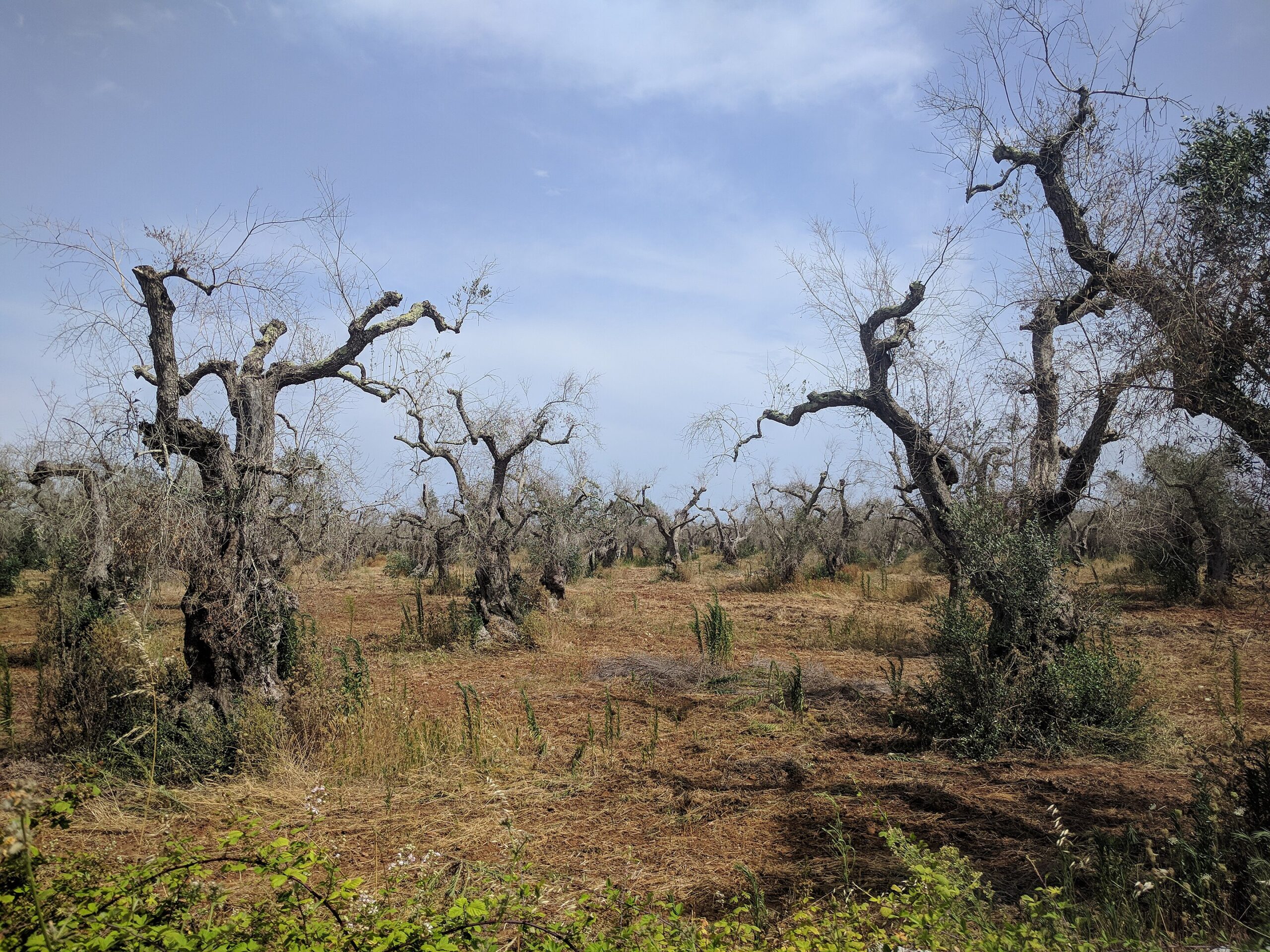
Olive trees define the Puglian landscape, and since 2013 they have been under attack from a bacterium, Xylella fastidiosa. First identified near Gallipoli that year, it has killed millions of trees across the Salento and moved steadily north, with huge economic and ecological damage. This guide explains how to recognise it, what you can and must do, and where research on treatments stands.
Xylella fastidiosa lives in the xylem, the vessels that carry water through a plant, and it is spread by insects that feed on xylem sap, above all the meadow spittlebug (Philaenus spumarius). The bacterium blocks the vessels, so water and nutrients no longer reach the leaves. The result is leaf scorch, wilting and eventually the death of whole branches, a condition known as Olive Quick Decline Syndrome (OQDS) in olive trees.
Early signs
Spotting the disease early matters. Look for leaves that turn brown and dry from the tip and edges, as if burnt; wilting of leaves and branches, especially in dry weather; branches and twigs dying back from the ends; and weak growth with falling yields. If you see these signs, act quickly.
Other problems can look similar, so a visual check is only the start. Confirmation needs a laboratory test on samples of affected leaves and twigs, usually by PCR. In Puglia, suspected cases should be reported to the regional plant health service (Osservatorio Fitosanitario), which runs monitoring and testing.
No cure: what to do now
There is still no cure for Xylella fastidiosa, but you can slow it down. Once infection is confirmed, follow the instructions of the plant health service, which in some zones include compulsory removal of infected trees. Pruning out affected branches may buy time, but it rarely saves a badly infected tree. Controlling the spittlebug is the most important step, because the insect is what carries the bacterium from tree to tree.
In Puglia this is a legal duty. Every spring, the Region orders owners of olive groves and other land to plough, harrow, rotovate or mow to kill the young spittlebugs before they can fly, by deadlines set each year. In 2026 the deadline was extended to 15 May in comuni below 200 metres above sea level and 30 May in those above. Insecticide treatments against adult insects may also be required in certain zones.
Where the bacterium has not yet spread widely, the rules focus on eradication: infected trees are removed and destroyed, and restrictions apply to moving plants that could carry the bacterium or its insects. Longer term, replanting with tolerant varieties such as Leccino and FS-17 (also sold as Favolosa), which can live with the infection and still crop, is the main hope for rebuilding olive groves in the worst-hit areas.
Signs of recovery
Some infected trees have shown signs of recovery after experimental treatments. In a 2016 statement on these new treatment approaches, however, the European Food Safety Authority (EFSA) made clear that these treatments do not remove the bacterium; at best they improve the health of the tree.
The European Commission asked EFSA to assess whether any of the treatments proposed could eliminate the bacterium from infected plants. The strain in Puglia, first called CoDiRO, is the one behind the rapid decline of olive trees across the region.
The experimental treatments
EFSA reviewed work by two Italian research groups: professors Carlucci and Lops from the University of Foggia and Professor Scortichini from CREA (Fruit Tree Research Unit, Caserta). Their field trials combined commercial fertilisers, fungicides and bioactive compounds, including formulations of zinc and copper, sometimes with citric acid. The trials also involved careful pruning, soil tillage, weed control and irrigation.
All the treated trees still tested positive for the bacterium, but both groups reported encouraging results. Treated trees grew more foliage and new shoots than untreated ones, and some produced a reasonable crop. In Professor Scortichini’s trials with zinc, copper and citric acid, treated trees were also reported to come through hot summers and cold winters better.
Preliminary findings
The EFSA Panel on Plant Health (PLH) stressed that the findings were preliminary. It accepted that the treatments seemed to improve the health of the trees, but noted that they did not remove the bacterium, that their long-term effect was unknown, and that multi-year studies and more data were needed to separate the effect of each part of the combined treatments.
What it means for olive growers
The panel also recognised that such treatments might extend the productive life of olive trees in infected areas and help manage groves, particularly in the containment zone. For now, there is no cure: the priorities are to control the spittlebug, follow the regional rules, report suspicious symptoms and, where trees are lost, replant with tolerant varieties.
References
- EFSA Panel on Plant Health (PLH); Scientific Opinion on the risks to plant health posed by Xylella fastidiosa in the EU territory, with the identification and evaluation of risk reduction options. EFSA Journal 2015;13(1):3989.
- European Food Safety Authority (EFSA). 2019. Update of the Xylella spp. host plant database, systematic literature search up to 30 June 2018. EFSA Journal 2019;17(5):5666.
- Saponari, M., Boscia, D., Altamura, G., D’Attoma, G., Cavalieri, V., Di Carolo, M., … & Martelli, G.P. (2017). Isolation and pathogenicity of Xylella fastidiosa associated with olive quick decline syndrome in southern Italy. Scientific Reports, 7(1), 17723.