Italy’s 7% flat tax for foreign pensioners has made Puglia one of the most talked-about places in Europe to retire. The region has the climate, the coast and the food; the tax regime adds a strong financial argument. The catch is that it only applies in smaller towns, so choosing where to live becomes part of the tax planning. This guide explains how the regime works and suggests towns worth a look, from Polignano a Mare on the Adriatic to the Baroque villages around Lecce.
What’s the 7% tax program in Italy
The regime, set out in article 24-ter of Italy’s income tax code (TUIR) and introduced by the 2019 Budget Law, lets people who receive a pension from abroad and move their tax residence to Italy pay a flat 7% substitute tax on all their foreign-source income, in place of ordinary income tax (IRPEF). According to the Agenzia delle Entrate, it applies to the year of the move and the nine years that follow, ten tax years in all. It is a separate scheme from Italy’s lump-sum regime for high-net-worth individuals, with which it is often confused.
What are the benefits of the 7% tax program?
The main benefit is the rate itself: a flat 7% on foreign income, including pensions, rental income and dividends, against ordinary IRPEF rates that rise to 43%. The substitute tax also replaces the regional and municipal income tax surcharges. Participants are exempt from Italy’s taxes on foreign property and financial assets (IVIE and IVAFE) and from the foreign asset reporting requirement, which simplifies paperwork considerably. And because the rate is fixed for the whole period, tax planning becomes predictable.
What are the requirements for the 7% tax program?
You must receive a pension paid by a foreign source, and you must not have been tax resident in Italy for the five tax years before the move, so people who have recently lived in Italy are excluded. You must move from a country that has an administrative cooperation agreement on tax matters with Italy (in practice, most countries with a tax treaty with Italy). If your pension is less conventional, such as a US Simplified Employee Pension (SEPP), check with an adviser that it counts. You can still work, although income produced in Italy is taxed in the ordinary way. And you must move to a qualifying town, described below. Italian citizens who have lived abroad, typically registered with AIRE, the register of Italians resident abroad, for at least five years, can also qualify.
A few practical rules follow from the law:
There is no separate application: you opt into the regime in your Italian tax return for the year you move, and the 7% tax is paid in a single instalment by the normal income tax deadline. Paying on time and in full matters, because persistent non-payment ends the regime. No deductions or tax credits can be set against the substitute tax, so renovation bonuses, personal deductions and foreign tax credits on the same income are not available. If you have income from several countries, you can exclude the income from specific countries, which is then taxed under the ordinary rules.
You must stay registered in a qualifying town. Moving to another eligible town keeps the benefit; moving to one that does not qualify, or leaving Italy, ends it. You can also withdraw from the regime at any time without penalty, but once you have withdrawn or lost it, you cannot opt in again.
Where can I move to in Italy for 7% tax?
The regime applies to towns in the Mezzogiorno region, Italy’s south, and to certain towns in central Italy affected by the 2009 earthquake and the 2016 and 2017 earthquakes, in regions such as Lazio, Marche and Umbria. The southern regions included are:
- Abruzzo
- Basilicata
- Calabria
- Campania
- Molise
- Puglia
- Sardinia
- Sicily
In these regions the town must have no more than 30,000 residents; the limit was 20,000 until 7 April 2026, when it was raised by law, so the towns below all qualify comfortably. If the town grows beyond the threshold after you register, you keep the 7% rate. Population is taken from ISTAT figures for 1 January of the year before your first tax year under the regime. So if you move in November 2026, the population on 1 January 2025 is the figure that counts.
Why retire in Puglia?
The climate comes first: mild winters and warm summers, often compared to Southern California, and pleasant weather for most of the year. Then there is the landscape, from a long coastline of sandy beaches and clear water to countryside of olive groves and vineyards. The cost of living is lower than in much of Italy, with more affordable housing and everyday expenses, so savings go further. And the region is rich in history, with handsome old towns, ornate churches, traditional architecture, excellent food and a calendar full of festivals.
Criteria for selecting the best towns in Puglia
We looked at safety, access to healthcare, infrastructure (transport, utilities and public services), everyday amenities such as shops, restaurants and parks, and the character of the community. Healthcare matters more with age, so a hospital within reasonable reach is worth prioritising. Above all, choose a real working town rather than a resort that empties out in winter or one dominated by expats; otherwise you may find little open, and little going on, from November to March.
The best Puglia towns to retire in
Ceglie Messapica
Population: 20,000
Ceglie Messapica, in the Brindisi hinterland, has a well-preserved medieval centre of winding lanes and old stone walls, and strong local traditions. It is best known for its food, a serious draw for anyone who loves traditional Apulian cooking, and for a warm, close community where newcomers are drawn into local celebrations.
Casarano
Population: 20,000
Casarano, in Salento, combines a historic centre with a busy modern town. Its palaces, churches and squares reflect its past, while an arts scene, cultural events, local markets and traditional festivals keep it lively all year.
Giovinazzo
Population: 20,000
Giovinazzo is a seaside town on the Adriatic, north of Bari, with cobbled streets, pale stone buildings and a pretty harbour. Its medieval walls enclose a maze of alleys that open onto small squares and markets. Fishing traditions and seafood are part of daily life, and the community is welcoming.
Casamassima
Population: 19,000
Casamassima, south of Bari, balances an old centre of narrow streets with the conveniences of modern life. Local festivals and events give it a strong sense of community, and traditional trattorias sit alongside modern amenities.
Carovigno
Population: 18,000
Carovigno, near the Adriatic coast in the province of Brindisi, pairs a tranquil seaside setting with a lively local culture. Its landmark is the Castello Dentice di Frasso, a reminder of the town’s medieval past. It has a good food scene built on local produce, and a warm community with plenty of cultural events and festivals.
Polignano a Mare
Population: 18,000
Polignano a Mare sits on limestone cliffs above the Adriatic, with clear blue water below. Its historic centre is a maze of narrow streets ending in panoramic viewpoints, and its coves and sea caves are made for swimming and exploring. The town has long inspired artists and writers.
Leverano
Population: 15,000
Leverano, in Salento, has Baroque architecture, olive groves around the town and a strong winemaking tradition. The historic centre has attractive squares and carved details, and the local wineries offer tastings and vineyard visits. Festivals bring traditional music, dance and food.
Oria
Population: 15,000
Oria, in the province of Brindisi, is a medieval town dominated by its castle. Its winding streets lead to small squares where residents gather for long-established festivals and good regional food, and newcomers tend to feel welcome.
Maglie
Population: 14,000
Maglie, in Salento, is a cultured market town of historic palaces and churches, with street art and contemporary galleries adding a modern note. Traditional festivals and open-air markets make it easy to get to know local life.
Locorotondo
Population: 14,000
Locorotondo sits on a hill in the Valle d’Itria, its circular old town of whitewashed houses looking out over the countryside. It is one of the “Borghi più belli d’Italia”, the association of Italy’s most beautiful villages. Its lanes mix Baroque and Renaissance architecture with flower-filled balconies, local artisans keep their workshops here, and traditional festivals bring music, dancing and food.
Cisternino
Population: 12,000
Cisternino, among the olive groves and hills of the Valle d’Itria, has kept its whitewashed lanes and traditional architecture remarkably intact. The historic centre shows medieval and Baroque influences, its old houses, including the pitched-roof cummerse, and terraces look out over the countryside, and local markets are full of fresh produce and crafts. It is also known for its food.
Alberobello
Population: 11,000
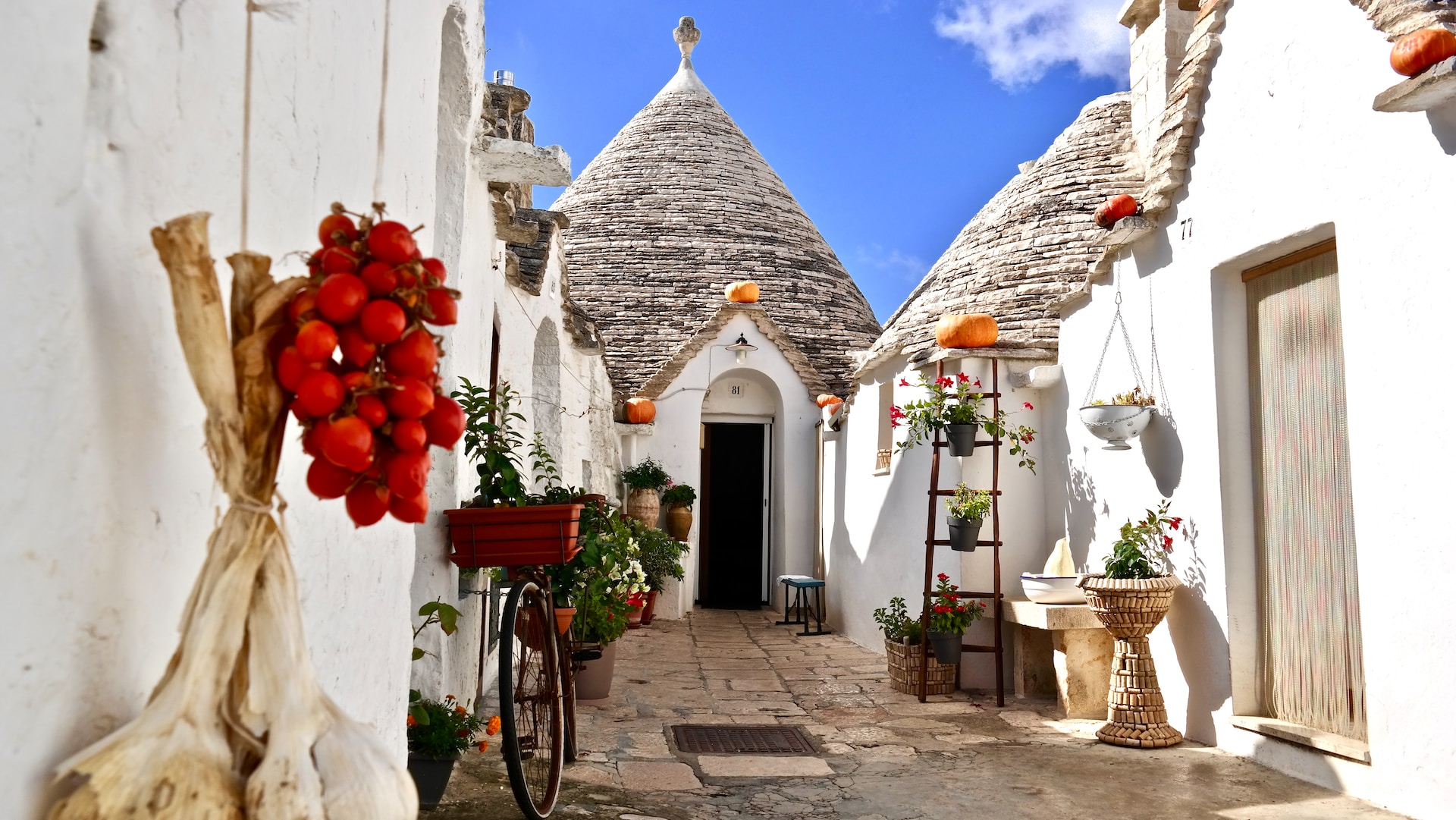
Alberobello is famous for its trulli, the conical-roofed limestone houses that earned it UNESCO World Heritage status. The trulli district is a living museum, with craft shops, cafés and galleries in the old houses, and festivals celebrate local music, dance and food.
San Pietro Vernotico
Population: 10,000
San Pietro Vernotico, near Brindisi, is a quiet, unassuming town with a traditional centre. Its markets of fresh produce and local crafts reflect its farming roots, and festivals show off a close-knit community.
Valenzano
Population: 10,000
Valenzano, just outside Bari, has a well-preserved historic centre of narrow lanes and handsome buildings. Local markets, festivals and cultural events keep it lively, and modern conveniences sit alongside traditional cafés and artisan shops.
Latiano
Population: 9,000
Latiano, in the province of Brindisi, is a calm town with a historic core of fine buildings and an unhurried pace of life. Local festivals celebrate its traditions and arts, and the community is known for being welcoming.
San Cesario di Lecce
Population: 8,000
San Cesario di Lecce is on the edge of Lecce, close enough for the city’s culture, restaurants and services, but with the quieter feel of a village. Its churches and buildings have fine Baroque façades, and local feasts bring traditional music and dance to the squares.
Ugento
Population: 8,000
Ugento, near the Ionian coast of Salento, combines history with some of the region’s best beaches, sandy and turquoise. Archaeological remains and medieval buildings recall its long past, and annual events and festivals bring music, dance and local food.
Matino
Population: 8,000
Matino, in the middle of the Salento peninsula, has narrow lanes, historic buildings and attractive courtyards. Markets and traditional festivals celebrate local folklore and food, and its position gives easy access to both the Adriatic and Ionian coasts.
Novoli
Population: 7,000
Novoli, near Lecce, has a well-kept historic centre of old buildings and churches. Local festivals, with traditional music, dance and food, bring residents and visitors together.
Campi Salentina
Population: 6,000
Campi Salentina, in Salento, is a traditional village of cobbled streets and historic buildings. Its central piazza is the heart of town life, where people gather to talk and celebrate, and its churches and cultural events reflect both old and contemporary arts.
San Michele Salentino
Population: 6,000
San Michele Salentino, in the province of Brindisi, is a peaceful village of whitewashed houses and flower-filled streets, with a warm community spirit. Its piazzas fill up for local festivals with traditional music, dance and food, and both the Adriatic and Ionian coasts are within reach.
Otranto
Population: 5,800
Otranto, on the Adriatic coast of Salento, has an Aragonese castle and a remarkable cathedral, as well as an art scene and cultural events. Its beaches and turquoise water make it one of the loveliest places on the coast.
Over to you
Retiring in Puglia under the 7% regime can make a real difference to your finances, in a region with a lower cost of living than most popular retirement destinations. Ceglie Messapica and Oria offer history and a quiet pace, Alberobello has its trulli and Carovigno its beaches, and every town here has its own character. Add the climate, the coast and the food, and Puglia deserves a place on any retirement shortlist. Take professional tax advice before you move, and spend time in a town, out of season as well as in summer, before you commit.