
Short answer: yes. Tap water across Puglia is supplied by Acquedotto Pugliese (AQP), whose labs analyzed about 55,000 samples in 2025, and it has to meet the same EU safety limits as tap water anywhere else in Italy. You can drink it in Bari, Lecce, Monopoli, Polignano a Mare, Ostuni and Brindisi. The catch is taste, hardness, and in Salento, nitrate levels that sit well within the legal limit but higher than some people are comfortable with. More on that below.
Updated October 2026 · Puglia Everyday research
Where Puglia’s tap water comes from
Puglia has almost no rivers or lakes of its own, because the limestone ground soaks rainwater straight down. So most of the region’s drinking water is piped in from elsewhere. According to AQP, roughly 55% comes from five reservoirs (Sinni, Pertusillo, Conza, Occhito and Locone), about 33% from mountain springs in Irpinia in Campania, and about 12% from around 170 wells, most of them in southern Puglia. The same network serves more than 4 million people, and in 2025 AQP’s ten laboratories checked about 1.7 million chemical and microbiological parameters (AQP press kit, July 2026).
That split matters when you read the rest of this post. Bari and the towns along the coast to Monopoli and Polignano mostly drink treated reservoir and spring water. Salento, around Lecce, relies more on groundwater from wells, and that’s where nitrates come from.
Tap water town by town
AQP publishes lab results for every town, updated every six months. You can look up your own on the AQP water quality page by typing the town name into the “Abitato” box.
Here are AQP’s latest published figures (July to December 2025) for the towns people ask about most:
| Town | Nitrate (mg/L) | Hardness (°F) | pH | Sodium (mg/L) | Dissolved solids (mg/L) | E. coli |
|---|---|---|---|---|---|---|
| Bari | 2 | 19 | 7.8 | 29 | 331 | <1 |
| Monopoli | 2 | 20 | 7.8 | 20 | 308 | <1 |
| Polignano a Mare | 2 | 20 | 7.7 | 21 | 315 | <1 |
| Ostuni | 2 | 18 | 8.0 | 15 | 278 | <1 |
| Brindisi | 2 | 18 | 8.0 | 12 | 258 | <1 |
| Lecce | 19 | 29 | 7.7 | 72 | 584 | <1 |
Key finding: Puglia Everyday research found that nitrate in Puglia’s tap water runs 12 to 32 mg/L in most Salento towns and 2 to 5 mg/L in the rest of the region, all under the 50 mg/L legal limit; for comparison, a north London supply zone averaged 27.5 mg/L in 2025, Rome’s network 5.8 mg/L and New York City about 0.6 mg/L (October 2026).

Cite this: Puglia Everyday research, “Nitrate in the tap”, October 2026, pugliaeveryday.com/family/can-i-drink-the-tap-water-in-puglia/ · Download the data (CSV)
The pattern is regional, not a Lecce quirk. Across most of Salento, AQP’s figures run from 12 mg/L in Nardò to 32 mg/L in Maglie and Galatina, with Lecce in the middle at 19. North of Salento, from Barletta and Bari to Monopoli, Ostuni and Taranto, nitrate sits at 2 to 5 mg/L. Every town is under the 50 mg/L legal limit.
For perspective, Salento’s numbers are in the same range as London’s: a north London supply zone averaged 27.5 mg/L in 2025, according to Thames Water. Rome’s network averaged 5.8 mg/L (Acea), and New York City, whose water comes from protected upstate reservoirs, about 0.6 mg/L.
London’s nitrate varies by supply zone: Thames Water’s 2025 averages were 27.5 mg/L in Muswell Hill & Hampstead Heath and 30.2 mg/L in Hackney South. We chart the first; both are in the same range as Salento.
| Place | Area | Nitrate (mg/L as NO3) |
|---|---|---|
| Maglie | Salento | 32 |
| Galatina | Salento | 32 |
| Gallipoli | Salento | 24 |
| Casarano | Salento | 21 |
| Otranto | Salento | 21 |
| Ugento | Salento | 20 |
| Lecce | Salento | 19 |
| Tricase | Salento | 19 |
| Nardò | Salento | 12 |
| Copertino | Salento | <5 |
| Foggia | Rest of Puglia | 5 |
| San Severo | Rest of Puglia | 5 |
| Lucera | Rest of Puglia | 4 |
| Bari | Rest of Puglia | 2 |
| Monopoli | Rest of Puglia | 2 |
| Polignano a Mare | Rest of Puglia | 2 |
| Ostuni | Rest of Puglia | 2 |
| Brindisi | Rest of Puglia | 2 |
| Barletta | Rest of Puglia | 2 |
| Andria | Rest of Puglia | 2 |
| Altamura | Rest of Puglia | 2 |
| Fasano | Rest of Puglia | 2 |
| Taranto | Rest of Puglia | 2 |
| Martina Franca | Rest of Puglia | 2 |
| Manduria | Rest of Puglia | 2 |
| London | Reference city | 27.5 |
| Rome | Reference city | 5.8 |
| New York City | Reference city | 0.6 |
For reference, the legal limit for nitrate in Italian drinking water is 50 mg/L (Legislative Decree 18/2023, which applies the EU Drinking Water Directive 2020/2184). The WHO guideline is also 50 mg/L.
Every measure against its legal limit
AQP tests 53 parameters in every town. We put the key ones on one scale, each as a share of its legal limit, so you can see how much headroom Puglia’s water has. Across all 25 towns, nothing breaks a limit, and no bacteria turned up anywhere.
Key finding: Puglia Everyday research found that no tap water reading in any of the 25 Puglia towns breaks a legal limit; the highest, chloride in Otranto, reaches 76% of its limit, and no bacteria were found anywhere (October 2026).

Cite this: Puglia Everyday research, “Is Puglia’s tap water safe to drink?”, October 2026, pugliaeveryday.com/family/can-i-drink-the-tap-water-in-puglia/ · Download the data (CSV)
| Measure | Legal limit | Highest town | Highest reading | Highest, % of limit | Median town | Median, % of limit |
|---|---|---|---|---|---|---|
| Chloride | 250 | Otranto | 190 | 76% | 43 | 17% |
| Nitrate | 50 | Maglie | 32 | 64% | 2 | 4% |
| Sodium | 200 | Otranto | 103 | 52% | 40 | 20% |
| Aluminum | 200 | Lucera | 109 | 54% | 60 | 30% |
| Sulfate | 250 | San Severo | 93 | 37% | 36 | 14% |
| Fluoride | 1.5 | San Severo | 0.5 | 33% | 0.2 | 13% |
| Conductivity | 2500 | Otranto | 1013 | 41% | 513 | 21% |
| Bacteria | 0 per 100 mL | None | <1 | 0% | <1 | 0% |
Water that is disinfected also carries small amounts of disinfection by-products. These are within their limits in every town too:
| By-product | Legal limit | Highest town | Highest reading | % of limit | Median |
|---|---|---|---|---|---|
| Trihalomethanes (µg/L) | 30 | Barletta | 17 | 57% | 11 |
| Chlorate (mg/L) | 0.70 | Lucera | 0.53 | 76% | 0.23 |
| Chlorite (mg/L) | 0.70 | Foggia | 0.52 | 74% | 0.31 |
| Bromate (µg/L) | 10 | All towns | <2 | under 20% | <2 |
Can you drink tap water in Bari?
Yes. AQP’s latest figures for Bari show nitrate at 2 mg/L (the legal limit is 50), no E. coli and moderate hardness. It’s safe straight from the tap, though older buildings can add a chlorine or pipe taste.
Can you drink tap water in Lecce?
Yes. Lecce’s water is within every legal limit, with nitrate at 19 mg/L. It’s harder and saltier than Bari’s (29 °F against 19 °F, sodium 72 mg/L against 29), which you’ll taste in a glass and see in the kettle. If you’re making infant formula, see the section on babies below.
Can you drink tap water in Monopoli and Polignano a Mare?
Yes. Both show nitrate at 2 mg/L and no E. coli in AQP’s July to December 2025 results, so you can drink and refill from the tap.
Can you drink tap water in Ostuni and Brindisi?
Yes. Both are among the softest in Puglia at 18 °F, with nitrate at 2 mg/L and no E. coli.
We tested tap water in Lecce
We ran a Watersafe drinking water test kit on tap water in Lecce. The nitrate strip read somewhere between 5 and 10 ppm, and the pH came out on the high side.
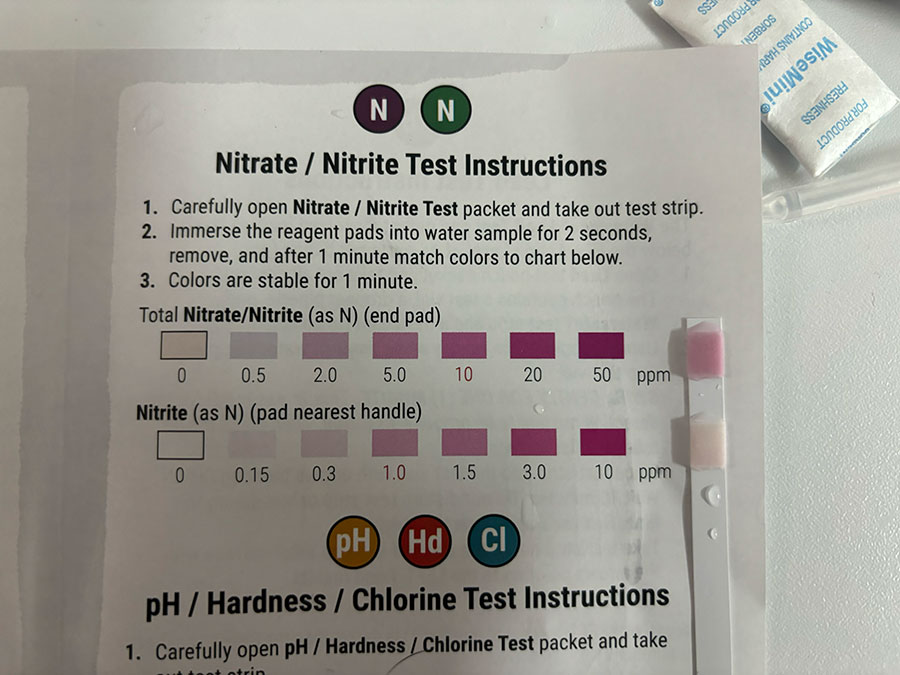
That’s one sample from one tap, so treat it as a rough check and not a lab result.
Is that a lot? It depends on the units
This is where we got it wrong in the first version of this post, so here’s the correction.
Nitrate can be reported in two ways, and they differ by a factor of about 4.4:
- As nitrate (NO3). This is how Italy, the EU, the WHO and AQP report it. The limit is 50 mg/L.
- As nitrogen (NO3-N). This is how the US EPA reports it. The limit is 10 mg/L, which equals about 45 mg/L as nitrate.
Our original post compared AQP’s Lecce figure at the time, 20 mg/L (as nitrate), to the EPA’s 10 mg/L (as nitrogen) and called it double the US limit. It isn’t. 20 mg/L as nitrate is about 4.5 mg/L as nitrogen (the latest figure, 19 mg/L, is about the same), which is under half the EPA limit and under half the EU limit.
Our kit’s color chart reports nitrate “as N”, in other words as nitrogen, as you can see in the photo above. So a reading of 5 to 10 ppm works out at about 22 to 44 mg/L as nitrate. That’s still under the legal limit, but in the upper half of it, and higher than AQP’s own lab figure for Lecce. Home test strips are only approximate, so AQP’s lab results are the more reliable number.
Why Salento has more nitrate
Studies of Salento’s groundwater have found nitrate concentrations rising over time, mainly from farm fertilizer leaching down into the aquifer. A 2023 study by Gabriella Balacco and colleagues in Groundwater for Sustainable Development mapped where the aquifer is most vulnerable. AQP’s treatment and blending keep the tap water within the legal limit.
The water source explains the split. Most of Puglia drinks reservoir water and Irpinia spring water piped in from outside the region, which is naturally low in nitrate. AQP’s own wells, about 12% of the supply, are mostly in the south, so Salento’s taps carry more local groundwater. Groundwater in much of Puglia is high in nitrate: an ISPRA study of the region’s aquifers found average levels above 50 mg/L in parts of the Tavoliere around Foggia, the Ionian coast near Taranto and the Gargano.
Tip for private wells: AQP’s figures cover the mains only. If your house, masseria or rental uses a private well, a lab test is affordable peace of mind, so have it tested before you drink it, and again every year or so.
Why so many locals still buy bottled water
Walk through any Puglia supermarket and you’ll see people loading six-packs of bottled water into their carts. Italy is one of the biggest bottled-water drinkers in the world, and Puglia is no exception. The reasons people usually give are taste, hard water, and habit.
Two practical points are worth knowing:
- Your building’s pipes matter. AQP is responsible for the water up to your meter. After that it runs through your building’s pipes and often a storage tank (serbatoio) with a pump (autoclave), which can affect taste and quality. AQP recommends cleaning and disinfecting private tanks at least once a year. In an older building, run the tap for a bit before drinking, especially first thing in the morning. If you’re moving into a new home, our guide on how to turn on utilities in Italy explains how to set up the water supply.
- Hard water is a taste and limescale issue, not a health one. You’ll notice it in the kettle and on the shower glass before you notice it in a glass of water.
Tap versus bottled: how mineral-rich is Puglia’s water?
We lined up AQP’s figures for dissolved minerals against three bottled waters you’ll find in any Puglia supermarket. The result surprised us: Salento’s tap water is almost as mineral-rich as San Pellegrino, while Bari’s is close to Evian. If you like the taste of a mineral water, the tap is already pouring something similar, for free.
Key finding: Puglia Everyday research found that Salento’s tap water carries nearly as many minerals as San Pellegrino (Otranto 709 mg/L against 860), while Bari’s 331 mg/L sits close to Evian’s 345 (October 2026).

Cite this: Puglia Everyday research, “Tap versus bottled”, October 2026, pugliaeveryday.com/family/can-i-drink-the-tap-water-in-puglia/ · Download the data (CSV)
| Water | Minerals (mg/L) | Measurement |
|---|---|---|
| San Pellegrino (bottled) | 860 | Label, measured at 180 °C |
| Otranto | 709 | AQP, calculated |
| Gallipoli | 674 | AQP, calculated |
| Lecce | 584 | AQP, calculated |
| Rome (2023) | 386 | Acea, calculated |
| Evian (bottled) | 345 | Label, measured at 180 °C |
| Bari | 331 | AQP, calculated |
| Brindisi | 258 | AQP, calculated |
| Acqua Panna (bottled) | 143 | Label, measured at 180 °C |
Hard water: great minerals, just descale the kettle
Hardness is what leaves white limescale in your kettle. Salento’s tap water, at 29 to 31 °F, is about as hard as Rome’s or London’s, and roughly ten times harder than New York’s soft reservoir water. Bari, Brindisi and Taranto are in the middle, at 18 to 19 °F.
This is a household chore, not a health issue. The World Health Organization says hardness is “not of health concern at levels found in drinking-water” and sets no health-based limit for it; calcium and magnesium in water can even add a little to your daily intake.
Tip: in Salento, descale your kettle and espresso machine about once a month with a citric acid or vinegar rinse, and use the machine’s hardness setting if it has one. In Bari, every two to three months is usually plenty.
Key finding: Puglia Everyday research found that Salento’s tap water runs 29 to 31 °F hardness, about as hard as Rome’s (32.9 °F) and London’s Hackney zone (27.8 °F) and roughly ten times New York’s 3.2 °F, while Bari, Brindisi and Taranto sit at 18 to 19 °F (October 2026).

Cite this: Puglia Everyday research, “How hard is the water?”, October 2026, pugliaeveryday.com/family/can-i-drink-the-tap-water-in-puglia/ · Download the data (CSV)
| Place | Hardness (°F) | Source |
|---|---|---|
| Rome (2018 network average) | 32.9 | Acea |
| Maglie, Galatina, Gallipoli, Casarano | 31 | AQP |
| Otranto | 30 | AQP |
| Lecce, Ugento, Tricase | 29 | AQP |
| London, Hackney South zone (2025) | 27.8 | Thames Water |
| Nardò | 24 | AQP |
| Bari, San Severo, Lucera, Copertino | 19 | AQP |
| Brindisi, Taranto, Ostuni, Andria, Barletta | 18 | AQP |
| New York City (2025) | 3.2 | NYC DEP |
Free and low-cost refills: fontanelle and case dell’acqua
Many towns have public drinking fountains fed by AQP, known locally as “cape de firr” in Bari dialect, and AQP’s free FontaninApp shows where they are. The same app lists bars and restaurants that serve AQP tap water in a carafe, which some places in Polignano a Mare, Vieste and Gallipoli have signed up for.
Many towns also have a casa dell’acqua, a kiosk that sells filtered still or sparkling water by the liter.
Babies and pregnancy
The nitrate limits exist mainly to protect babies under six months, who are more sensitive to nitrate. Tap water within the legal limit is considered safe. If you’re making formula and want extra margin, look for an Italian mineral water labeled as suitable for infants (“indicata per l’alimentazione dei lattanti” or “indicata per la preparazione degli alimenti dei lattanti”): waters intended for infants must have 10 mg/L of nitrate or less. Check the nitrate figure printed on the label, and ask your pediatrician if you’re unsure.
Should you use a filter?
It depends on what you want to fix:
- Chlorine taste: a basic jug filter with activated carbon helps.
- Limescale: a jug filter with an ion-exchange cartridge softens the water a bit.
- Nitrate: standard carbon filters don’t remove it. You’d need reverse osmosis, ion exchange designed for nitrate, or distillation.
The bottom line for visitors
If you’re visiting Bari, Monopoli, Polignano a Mare, Ostuni or Brindisi for a week, drink the tap water, refill your bottle at fountains, and don’t worry about it. If Monopoli is your base, our guide to staying in Monopoli covers the trains, beaches and old-town parking rules. Staying in Salento? Our Lecce guide gathers everything for the city, and Lecce as a base for Salento covers the trains and beach buses. If you’re moving to Salento long term and nitrate concerns you, look up your town on the AQP site, test your own tap, and decide whether a reverse osmosis filter is worth it for your household.
Quick answers from our research
Is Lecce tap water safe to drink?
Yes. Acquedotto Pugliese’s July to December 2025 results show nitrate at 19 mg/L, under the 50 mg/L legal limit, and no E. coli. It is harder and saltier than the water in Bari.
Is Lecce the only town with higher nitrate?
No. Most Salento towns run 12 to 32 mg/L, with Maglie and Galatina highest at 32, while the rest of Puglia sits at 2 to 5 mg/L. All are under the 50 mg/L limit.
How does Puglia’s tap water compare with London, Rome and New York?
Salento’s 12 to 32 mg/L is close to a north London zone’s 27.5 mg/L average in 2025. Rome averaged 5.8 mg/L and New York City about 0.6 mg/L, similar to or below northern Puglia’s 2 to 5.
Which towns have the softest tap water?
Brindisi, Ostuni, Taranto, Andria and Barletta, at 18 °F in AQP’s latest results. Salento towns are the hardest, at 29 to 31 °F.
Where does Puglia’s tap water come from?
According to Acquedotto Pugliese, about 55% comes from five reservoirs, about 33% from springs in Irpinia and about 12% from around 170 wells.
Is Puglia tap water as mineral-rich as bottled water?
In Salento, nearly. Otranto’s tap water has 709 mg/L of dissolved minerals against 860 for San Pellegrino, and Bari’s 331 mg/L is close to Evian’s 345.
Is Puglia’s hard water bad for you?
No. Salento’s 29 to 31 °F is similar to Rome and London, and the WHO says hardness is not a health concern at drinking-water levels. It mainly means descaling your kettle and espresso machine more often.
Does any Puglia tap water break a legal limit?
No. In AQP’s July to December 2025 results for 25 towns, the highest reading, chloride in Otranto, reaches 76% of its limit, and no bacteria were found.
How often is Puglia’s tap water tested?
Constantly. In 2025 Acquedotto Pugliese analyzed about 55,000 samples, roughly 1.7 million chemical and microbiological parameters, in its ten laboratories, and it publishes results for every town every six months.
Sources (all checked 26 October 2026)
- Acquedotto Pugliese, water quality by town
- Acquedotto Pugliese, water sources (55% reservoirs, 33% Irpinia springs, 12% wells) and advice on private storage tanks
- Acquedotto Pugliese, press kit, July 2026 (55,000 samples and 1.7 million parameters in 2025; 10 laboratories; more than 4 million people served)
- Acquedotto Pugliese, supply system and six water schemes
- Acquedotto Pugliese, FontaninApp and tap water in carafes
- Italian Legislative Decree 18/2023, Annex I (nitrate limit 50 mg/L)
- US EPA, nitrate rule overview (limit 10 mg/L as nitrogen)
- Virginia Tech Extension, nitrate units (10 mg/L NO3-N = 45 mg/L NO3) and treatment options
- Balacco G. et al., “Assessment of groundwater nitrate pollution using the Indicator Kriging approach”, Groundwater for Sustainable Development 21 (2023), 100920
- Italian Ministry of Health Decree of 10 February 2015, article 2(4) (nitrate limit of 10 mg/L for waters intended for infants)
- NYC DEP, 2025 Drinking Water Supply and Quality Report (nitrate 0.14 mg/L as nitrogen, 2025 average)
- Thames Water, water quality report 2025, zone 0353 Muswell Hill & Hampstead Heath (nitrate 27.5 mg/L mean)
- Acea, 2023 sustainability report, water quality, table 59 (Acea Ato 2 nitrate 5.8 mg/L average)
- ISPRA, Memorie descrittive della Carta geologica d’Italia vol. 92 (2014), ch. 21, nitrate in Puglia’s groundwater
- World Health Organization, Guidelines for Drinking-water Quality, hardness fact sheet (“not of health concern at levels found in drinking-water”)
- Thames Water, water quality report 2025, Hackney South zone (hardness 278 mg/L as CaCO3, nitrate 30.2 mg/L mean)
- Acea, Bilancio di sostenibilità 2018, table 53, p. 191 (Rome hardness 32.9 °F network average)
- San Pellegrino label (dissolved solids at 180 °C: 860 mg/L)
- Evian label (dissolved solids at 180 °C: 345 mg/L)
- Acqua Panna label, analysis by the University of Pavia, 12 September 2024 (dissolved solids at 180 °C: 143 mg/L; hardness 10.8 °F)