
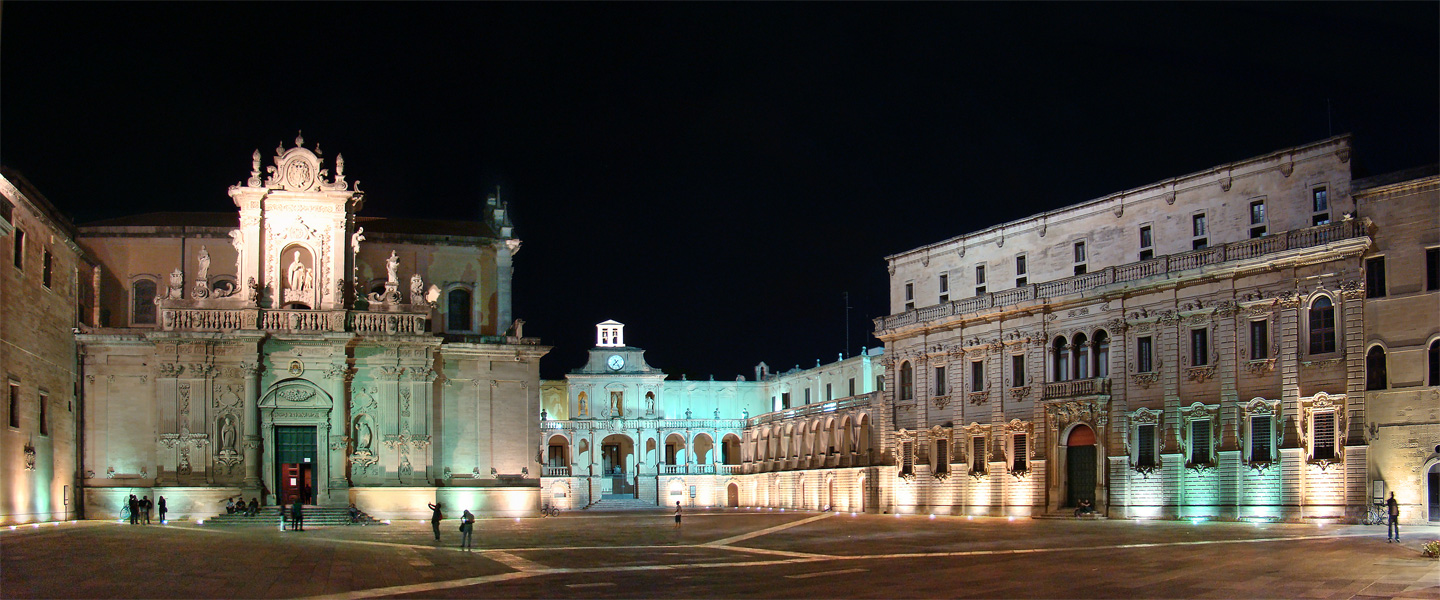
Lecce, capital of the province of the same name, has a history that goes back almost three thousand years. The Messapii, an ancient Italic people, settled the area around the 8th century BC. Under Rome the city prospered as a centre of trade, and in the Byzantine period it became the seat of a bishop. Normans, Swabians and Aragonese all came and went, and the city was walled against a long line of invaders.
From the late 16th century, and above all in the 17th, Lecce enjoyed a period of great prosperity that gave the city its signature style, the barocco leccese, or Lecce Baroque. Palaces, churches and public buildings went up in a local limestone, Lecce stone, soft enough to carve like wood and warm gold in colour. The Basilica of Santa Croce is the most famous example; another is Piazza del Duomo, with the Cathedral of Lecce, dedicated to the Assumption of the Virgin, at its heart.
In the 19th and early 20th centuries, Lecce remained a cultural and economic centre, known for agriculture and particularly for its olive oil and wine, and several of its intellectuals played a part in the movement for Italian unification. Today visitors come for the historic centre, the food and the easy pace of the streets, where the city’s long history is visible at every turn, from Roman ruins to Baroque façades.
What makes Lecce the “Florence of the South”?
Lecce owes the title to its artistic heritage. It is less famous than Florence and more understated, but its Baroque churches and palaces, with their elaborate carved façades, stand comparison with anything in Italy.
The city has long been the artistic centre of the Salento peninsula. Lecce stone, soft and easy to work, has been carved by local craftsmen for centuries, and the tradition survives in workshops where stone carving is still practised. There is a contemporary art scene too, with galleries and exhibitions showing local and international artists.
Lecce is less visited than the great cities of the north, which is part of its appeal. Walk its narrow streets and the honey-coloured stone glows against a clear blue sky. The pace is relaxed, and the city feels lived in rather than performed.
Add welcoming locals and excellent food. Traditional dishes include orecchiette with cime di rapa (turnip greens), cured meats and local wines, and the piazzas and outdoor markets are the best places to see the city at its liveliest.
What is the significance of the Baroque style in Lecce?
Baroque is Lecce’s defining style, seen above all in its richly carved façades. It flourished in the 17th and 18th centuries, and among its leading architects was Francesco Antonio Zimbalo, whose inventive, highly detailed work helped reshape the city.
Lecce Baroque is exuberant and theatrical, designed to impress. Buildings carry elaborate cornices, carved columns and sculpture, all worked in the local limestone, pietra leccese, which gave architects and sculptors the freedom to carve in such detail.
The Palazzo dei Celestini, built in the 17th century, is a fine example. Its façade is covered in carved reliefs and sculpted figures, and the play of light and shadow gives the whole composition depth. It shows Lecce’s architects and stone carvers at their best.
The style extends to the city’s many churches, the Basilica di Santa Croce above all. Its exterior is lavishly decorated with sculpture and reliefs drawn from the Bible and Christian iconography, and the interior is just as richly worked, with ornate altars.
What are the notable landmarks in Lecce?
Palazzo del Seggio
The Palazzo del Seggio, known locally as the Sedile, was built between 1588 and 1592 and served as the city’s town hall until the mid-19th century. Its façade is decorated with fine carving, and its tall pointed arches are a landmark of Piazza Sant’Oronzo. The building has since been used for exhibitions and cultural events, and is worth a look for anyone interested in the city’s history and architecture.
Basilica of Santa Croce
The Basilica of Santa Croce is the masterpiece of Lecce Baroque and one of the most important religious buildings in the city. Work on it began in the 16th century, and its façade is a riot of carved figures and decorative detail. Inside are an elegant nave and a fine altar, and the atmosphere is calm. It is essential for anyone interested in art, history or architecture.
Castle of Charles V
The Castle of Charles V was built in the 16th century for the Holy Roman Emperor Charles V, to defend the city against invaders. It is an impressive piece of military architecture, with massive walls and bastions. Around its large central courtyard stand Renaissance-style buildings, added later during Spanish rule. Today it is used for exhibitions and cultural events, and remains one of the great symbols of the city’s past.
Lecce Cathedral
Lecce Cathedral, the Cathedral of Santa Maria Assunta, was rebuilt in its present Baroque form in the 17th century. Carving and statues cover the exterior, and inside there are richly decorated chapels and a grand main altar. It is one of the most sumptuous interiors in the city.
Roman Amphitheatre
Lecce’s Roman amphitheatre lies half-excavated in Piazza Sant’Oronzo, in the middle of the modern city. According to the regional museums authority, it dates from the Augustan period, with later work under Hadrian, measured about 102 by 82 metres and held between 12,000 and 14,000 people. Gladiator fights and animal hunts were staged in its elliptical arena. Today about a third of it is visible, and it forms an open-air monument at the heart of the old town.
Bell Tower
The bell tower of Lecce Cathedral, built by Giuseppe Zimbalo between 1661 and 1682, rises about 70 metres over Piazza del Duomo, with five tapering storeys topped by a majolica-tiled dome. A panoramic lift takes visitors up to 43 metres, and from the top, on a clear day, you can see the Adriatic and even the mountains of Albania.
Must visit piazzas in Lecce
In Italy the piazza is the heart of town life, the place to meet, talk and be seen. These are the squares to know in Lecce.
Piazza del Duomo
Piazza del Duomo is one of the finest Baroque squares in Italy, enclosed on almost every side. The Cathedral of Lecce, also known as the Basilica of Santa Maria Assunta, dominates it, with a façade covered in statues and carving. Around it stand the Palazzo del Seminario, the former seminary, and the Palazzo Vescovile, the bishop’s palace, with its Renaissance architecture. It is a gathering place for locals and visitors alike.
Piazza Sant’Oronzo
Piazza Sant’Oronzo is the city’s main square, with layers of history on show. Part of it is taken up by the Roman amphitheatre, whose ruins you can look down on from the square. Its centrepiece is the Column of Sant’Oronzo, crowned by a statue of the city’s patron saint and a reminder of Lecce’s religious traditions.
Piazza Giuseppe Mazzini
Piazza Mazzini is Lecce’s modern centre, spacious and well planned, with seating and green space. It is a popular meeting place, where friends and families spend their evenings, and the surrounding cafés and restaurants serve both local and international food, from a quick espresso to a gelato. It is the city’s main shopping area too.
Visiting Lecce’s churches and basilicas
Lecce has an extraordinary number of Baroque churches, their façades carved with sculpture, columns and ornament, their interiors full of altars, frescoes and gilding. Beyond Santa Croce, already mentioned, these are the ones to see.
Duomo di Lecce – Cattedrale Maria Santissima Assunta
The Duomo di Lecce was rebuilt in the 17th century and is the religious heart of the city. Its bell tower is visible from far around, its entrance is richly carved in the Baroque manner, and inside are frescoed ceilings, a splendid altar and chapels full of statues and relics. It remains a working place of worship.
Chiesa di San Matteo
The Chiesa di San Matteo is easy to walk past, but it rewards a closer look. Inside, the Baroque decoration of its columns, walls and ceilings is remarkably detailed, and its altars and statues are beautifully preserved. It deserves to be better known.
Chiesa di San Giovanni Battista
The Chiesa di San Giovanni Battista, in the historic centre, has been a place of worship for centuries. Its exterior shows fine stonework and a tall bell tower, and the interior is decorated with frescoes and religious works of art. It is a quiet, rewarding stop.
Exploring the archaeological sites in and around Lecce
The Historic Center of Lecce
The historic centre is itself an archaeological site. Parts of the old city walls survive, and within them are several important finds. The Roman amphitheater, once the setting for gladiator fights, is the most famous. Underground olive oil mills, dug into the rock, show how the city produced one of its most valuable commodities, and some can be visited. Just outside the old walls, next to the monumental cemetery, stands the city’s most important medieval church, Santi Niccolò e Cataldo. It was founded in 1180 by the Norman count Tancred of Lecce (later King of Sicily) and is a key example of Apulian Romanesque architecture. When the facade was rebuilt in Lecce Baroque style in 1716 by Giuseppe Cino, the original carved portal and rose window were kept, so you can see both eras side by side.
The Roman Ruins of Rudiae
One of the most important sites near Lecce is Rudiae, about 3 km south-west of the center. It began as a Messapian settlement, inhabited from the 7th century BC and enclosed by walls about 4 km long in the 4th century BC, and it came under Roman control in the 3rd century BC. It was also the birthplace of the Latin poet Ennius (239-169 BC). Rudiae flourished between the 5th and 3rd centuries BC and then gradually declined as nearby Roman Lupiae (today’s Lecce) grew in importance (Parco Archeologico di Rudiae). The most notable discovery is a Roman amphitheatre, built during the reign of the emperor Trajan (98-117 AD), whose existence was confirmed by excavations between 2011 and 2017. Excavations have also uncovered mosaic floors and a large quantity of pottery, which shed light on daily life and on the trade links of the ancient town.
The Messapian Walls and Tombs
The Messapians, the indigenous people who settled the area from around the 8th century BC, left a lasting mark. Stretches of the walls they built survive, massive stone structures that once enclosed and protected their settlements.
Their tombs, often found close to the walls, have yielded pottery, jewellery, weapons and tools, which have helped archaeologists understand Messapian art, technology, trade and beliefs. Burial practices varied, with some tombs holding several burials and others showing signs of elaborate rituals.
Together, the walls and tombs are the best way to meet the civilisation that shaped this corner of Puglia long before Rome.
The Archaeological Park of San Pietro in Lama
Just outside Lecce, San Pietro in Lama has an archaeological area with the remains of old farmhouses (masserie) and a basilica with mosaic floors dating back to the Roman era. The stone farmhouses show how rural life was organised, and the mosaics are the highlight.
Excavation and research continue, focusing on the lives, customs and economy of the people who lived here, and new finds are still being made. It is a rewarding detour for anyone with an interest in the region’s past.
More things to do in Lecce
Beyond the monuments, much of Lecce’s appeal lies in simply wandering the old town. Its cobblestone lanes, courtyards and piazzas are lined with small shops, cafés and bakeries: stop for a pasticciotto, the local custard-filled pastry, and in summer keep an ear out for pizzica, the traditional folk dance of Salento, at festivals and evening concerts. For dinner, see our favorite local restaurants in Lecce.
If you’re in town with children, the Lecce children’s museum is a hands-on museum for kids from 6 months to 12 years.
Day trips from Lecce
Lecce’s position in the Salento peninsula also makes it a practical base for exploring the rest of Puglia. Both the Adriatic and the Ionian coasts are within easy reach, and the nearest beach, San Cataldo, is only about 11 km away; you can even get to the beach from Lecce by bus. Further afield, these are the classic day trips (driving times are approximate):
- Ostuni (about 1 hour): the “White City”, a whitewashed hilltop old town overlooking the Adriatic, with a late-Gothic cathedral.
- Grottaglie (about 1 hour): a town known for its ceramics quarter, where artisans still work in small workshops.
- Alberobello (about 1.5 hours): the UNESCO-listed Rione Monti district is packed with trulli, the conical-roofed stone houses of the Valle d’Itria.
- Castellana Caves (about 1.5 hours): the Grotte di Castellana can only be visited on guided tours, either a 1 km route of about 50 minutes or the full 3 km route of about 100 minutes, which ends at the Grotta Bianca.
- Polignano a Mare (about 1.5 hours): a clifftop town above the Adriatic, famous for its sea caves.
- Matera (about 2.5 hours): just over the border in Basilicata, its Sassi cave dwellings are a UNESCO World Heritage site.