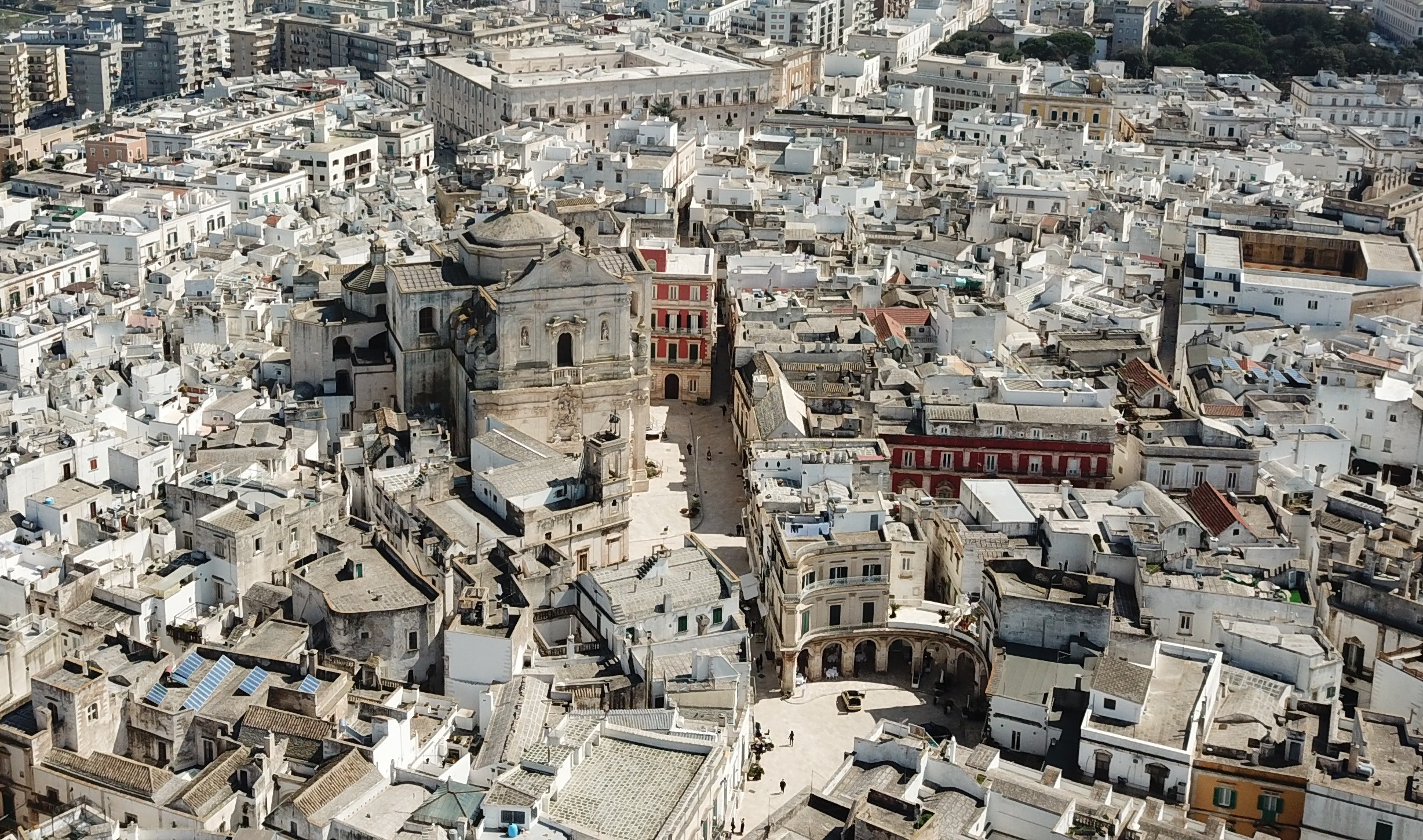
Martina Franca sits on a hill above the Valle d’Itria, one of the largest towns in the valley and, for many, the most rewarding to walk. Martina Franca has prehistoric roots, but it really grew after 1310, when Philip of Anjou granted it tax-free status and other privileges. Its golden age came in the 18th century, when the town’s grandest monuments went up in a style of its own, the Martinese Baroque. Modern districts now ring the old town, which makes the step through the gates all the more striking.
Is Martina Franca worth a visit?
Alberobello and Locorotondo get more attention, which is rather to Martina Franca’s advantage: it feels further from the tourist trail, and closer to everyday life. It is the largest town in the Itria Valley, and its historic centre is a well-kept maze of narrow lanes, whitewashed houses and Baroque churches. Plain white walls and pale stone sit next to extravagant carved balconies, and small squares open up where you least expect them. Bring a camera, and comfortable shoes.
An easy day trip in Puglia
With about 49,000 inhabitants, Martina Franca is a working town rather than a museum piece. The newer quarters are ordinary; the reason to come is the old centre, which is compact enough to see in a day. It makes a good stop on a tour of the region, and a fine companion to Lecce if you enjoy Baroque architecture. Wander the lanes, stop for coffee in the main square, look out for the summer festivals, and leave room for lunch.
Porta di Santo Stefano: the way into the old town
The walk starts at the town’s old gate, Porta di Santo Stefano, also known as Arco di Sant’Antonio, which opens off Piazza XX Settembre. The old town once had walls with 24 watchtowers and four gates, named after Santo Stefano, San Nicola, San Pietro and Santa Maria. The walls changed a great deal after Italian unification in 1861, but the gates remain as markers of the old boundary. Porta Santo Stefano, a Baroque gate whose history goes back to the 15th century, is the grandest of them and the natural place to begin.
Palazzo Ducale: the Caracciolo residence
Next comes the Palazzo Ducale, built in the 17th century for the powerful Caracciolo family. The entrance is framed by a carved Baroque portal. Guided tours take you through the frescoed halls and up the grand staircase, and give a good sense of how the town’s noble families lived and entertained.
The white lanes of the old town
From the palace, the lanes narrow and turn white. Potted plants line the steps, iron balconies hang overhead, and small artisans’ workshops and cafés sit between the houses. Follow your nose to the butchers: Martina Franca is known for capocollo, a cured pork speciality, and its smell drifts out of the traditional shops.
Basilica di San Martino: Baroque at full volume
The lanes lead to the Basilica di San Martino, dedicated to Saint Martin of Tours and built in the 18th century. Its carved façade is the high point of Martinese Baroque, and the interior, all light and shadow, is worth a few quiet minutes.
Piazza Plebiscito: the town’s living room
In front of the basilica lies Piazza Plebiscito, the everyday centre of Martina Franca. Cafés and small shops line its edges, and it is where the town gathers for events and festivals. It is the obvious place for a coffee and a pause to watch local life go by.
Church of San Domenico: a quiet interlude
A short walk away is the Church of San Domenico, founded by Dominican friars in the 14th century. The interior is simple and elegant, with works by local and regional artists, and it is a calm retreat from the busier streets. Look for the cloister, easy to miss and well worth finding.
La Lama: the lower town
Head downhill to La Lama, once the poorest district of Martina Franca. Well-preserved 18th-century buildings stand beside simpler houses that still show their age, and here the white gives way to coloured doors, shutters and balconies. It is less grand than the streets near the main gate, and all the more interesting for it.
La Cropolidi Puglia olive oil mill: a taste of tradition
The walk ends at La Cropolidi Puglia, an olive oil mill that also shows visitors how the oil is made. It is a good outing for children who have never seen an olive press. Details are on the mill’s website.
Local cuisine and dining
Come hungry. Puglia’s cuisine is rooted in the land and refreshingly unfussy: good bread, extra virgin olive oil, local cheeses and handmade orecchiette, the region’s signature pasta. In Martina Franca, look for trattorias serving capocollo and bombette, small stuffed rolls of meat, with a glass of Primitivo. It is easy to see why Puglia is gaining a name as a wine destination.
Worth planning for: the Valle d’Itria Festival
Each year, from late July into early August, Martina Franca hosts the Valle d’Itria Festival, an opera and classical music festival staged in venues such as the Palazzo Ducale and the Basilica di San Martino. Its programme has covered more than 100 works, from the well known to the rarely performed. Time your visit well and you may also catch the Festa di San Martino, the feast of the town’s patron saint, with processions, music and plenty of food in the streets.