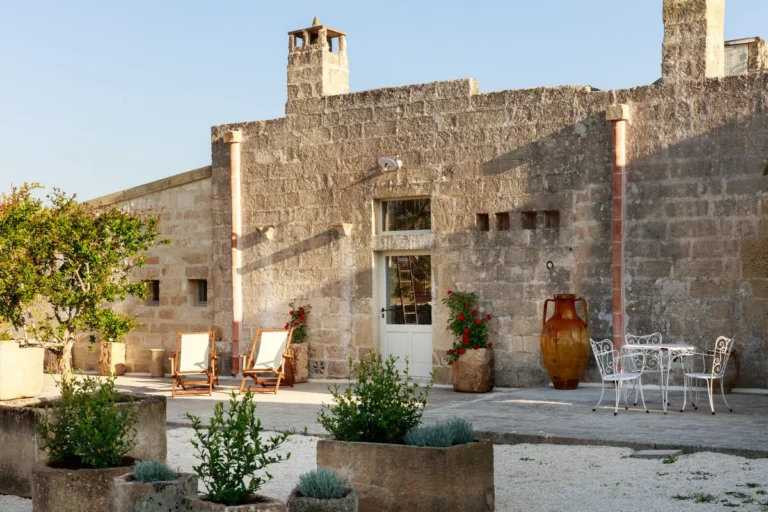
Photo by Luca, portfolio on Unsplash
Lecce is the rare Italian city that feels both ancient and young. Its streets are built in a honey-colored stone carved like lace, its main square sits on top of a Roman amphitheater, and on a weekday morning the people filling its cafés are as likely to be students as tourists. This is our portrait of the city: where it came from, what it is like now, and what the numbers say.
Updated October 2026 · Puglia Everyday research
Our verdict
Lecce is the cultural capital of the Salento and the best city base in southern Puglia: compact, beautiful and lived in, with about 94,000 residents and a university of more than 20,000 students. Visitors are discovering it fast, with tourist nights up 23% in 2024 alone. Give it at least two full days, and walk it with our Lecce walking tour. Our practical guide to Lecce as a base for Salento covers the trains, buses, parking and costs.
Three thousand years in one city
Long before the baroque, this was Messapian country. The Messapii, an Italic people, settled the area from around the 8th century BC, and their town of Rudiae, about 3 km southwest of today’s center, was enclosed by walls about 4 km long in the 4th century BC. Rudiae came under Roman control in the 3rd century BC and was the birthplace of the Latin poet Ennius; it slowly declined as nearby Roman Lupiae, today’s Lecce, grew (Parco Archeologico di Rudiae).
Rome left its mark in the middle of town. Lecce’s amphitheater lies half-excavated in Piazza Sant’Oronzo. According to the regional museums authority, it dates from the Augustan period, with later work under Hadrian, measured about 102 by 82 meters and held between 12,000 and 14,000 people. About a third of it is visible today, so modern Lecce quite literally walks around the edge of an ancient arena.
Byzantines, Normans, Swabians and Aragonese followed. The Norman count Tancred of Lecce, later King of Sicily, founded the church of Santi Niccolò e Cataldo in 1180, and the city was fortified in the 16th century with the Castle of Charles V.
The baroque boom, and the stone that made it
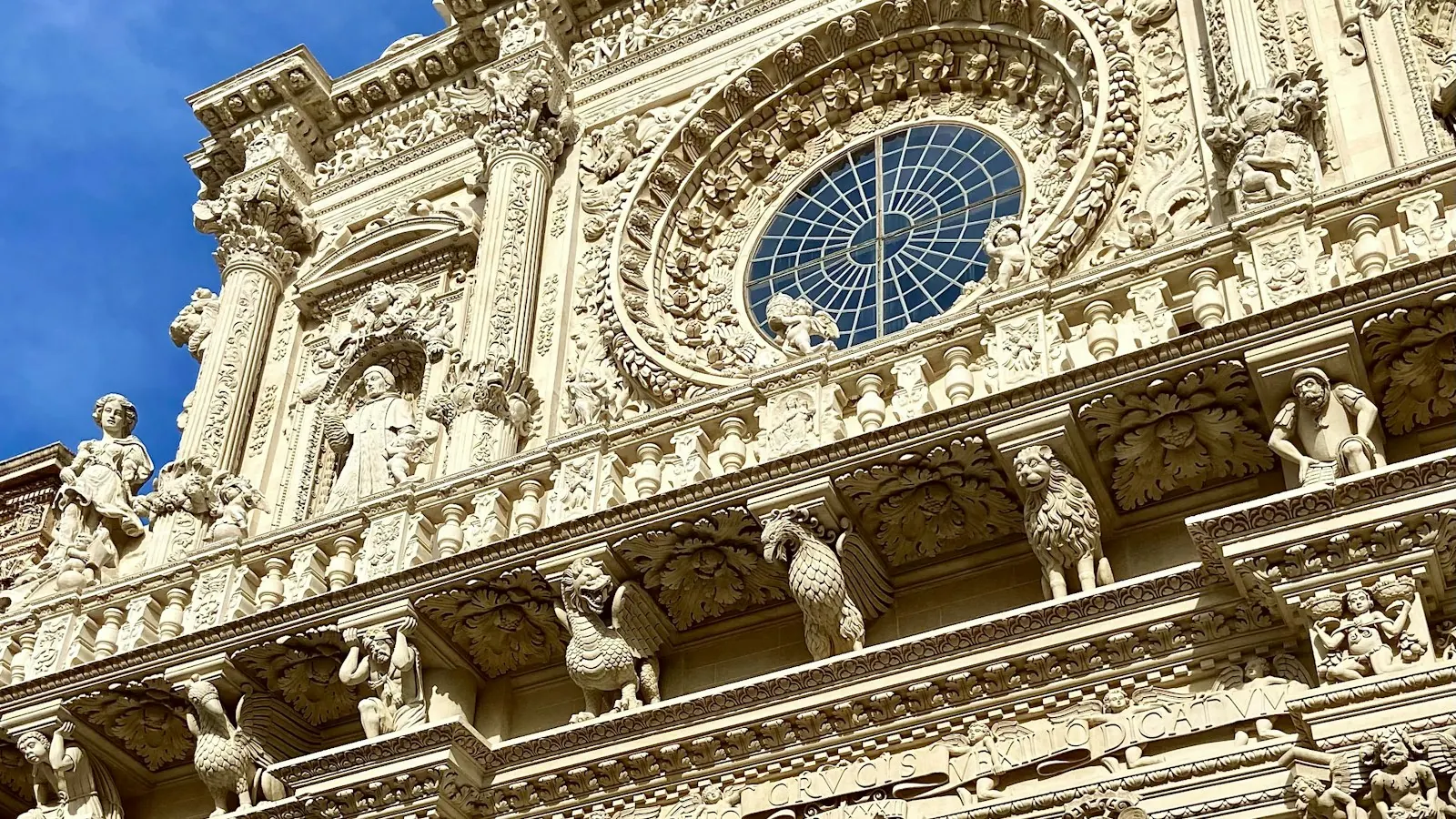
From the late 16th century, and above all in the 17th, Lecce enjoyed a period of great prosperity, and it spent it on stone. Palaces, churches and public buildings went up in pietra leccese, a local limestone soft enough to carve like wood and warm gold in color. That softness is the whole secret of barocco leccese, or Lecce Baroque: façades crowded with cornices, columns, fruit, cherubs and grotesque figures that would have been far harder to cut in marble or granite.
The style has its signature buildings. The Basilica of Santa Croce, begun in 1549 and finished almost a century later, is the masterpiece (Basilica di Santa Croce). In Piazza del Duomo, Giuseppe Zimbalo built the cathedral’s bell tower between 1661 and 1682, five tapering stories rising about 70 meters (Visit Lecce). The tradition never quite stopped: stone carvers still work in the city, which is why it has been nicknamed the “Florence of the South”.
Lecce now
Today Lecce is a mid-sized provincial capital with 94,187 residents at the end of 2024, according to ISTAT (Tuttitalia). The population has been broadly stable for two decades, and households are small: 47,497 of them, averaging 1.97 people each. Like much of Italy, the city is aging, with 547 births against 1,114 deaths in 2024.
What keeps it young is the university. The Università del Salento had 20,774 students enrolled on degree courses in 2024/25 (Università del Salento), which gives the old town its evening energy and its year-round cafés and bookshops.
Tourism is the other big story. In 2024 the city recorded 375,484 tourist arrivals and about 1.06 million tourist nights, up 9% and 23% on 2023, putting Lecce second in Puglia for arrivals, behind only Bari (LeccePrima, reporting Pugliapromozione data). Two years earlier, in 2022, the figures were 273,855 arrivals and 673,743 nights (LeccePrima).
The data
| Year | Tourist arrivals | Tourist nights | Source |
|---|---|---|---|
| 2022 | 273,855 | 673,743 | Pugliapromozione via LeccePrima |
| 2023 | 310,504 | 773,386 | Pugliapromozione via LeccePrima |
| 2024 | 375,484 | about 1,063,000 | Pugliapromozione via LeccePrima |
Key finding: Puglia Everyday research (October 2026): Lecce, a city of 94,187 residents, recorded 375,484 tourist arrivals and about 1.06 million tourist nights in 2024, roughly four arrivals for every resident and an average stay of 2.8 nights (our calculation from ISTAT and Pugliapromozione data).

Cite this: Puglia Everyday research, “Lecce: 2,300 years in seven moments”, October 2026, pugliaeveryday.com/travel/lecce-a-beautiful-baroque-city-known-as-the-florence-of-the-south/ · Download Lecce by the numbers (CSV)
Lecce by the numbers, in plain text:
| Figure | Value | Source |
|---|---|---|
| Residents, 31 December 2024 | 94,187 | ISTAT via Tuttitalia |
| University students, 2024/25 | 20,774 | Università del Salento |
| Tourist nights, 2024 | about 1.06 million (up 23%) | Pugliapromozione via LeccePrima |
| Tourist arrivals, 2024 | 375,484 (up 9%) | Pugliapromozione via LeccePrima |
| Arrivals per resident, 2024 | about 4 | Our calculation |
| Average stay, 2024 | 2.8 nights | Our calculation |
Two things stand out. Visitors are staying longer: the average stay rose from about 2.5 nights in 2022 to 2.8 in 2024 (our calculation), a sign that Lecce is becoming a base rather than a day stop. And between 2022 and 2024, tourist nights grew by about 58% while the resident population barely moved.
What surprises people about Lecce
- The arena under the shopping street. The Roman amphitheater sits in the city’s main square, ringed by cafés and shops.
- It is more Roman than it looks. Mayor Adriana Poli Bortone has pointed out that the city’s territory holds four Roman theaters and amphitheaters (Corriere Salentino).
- The lace is limestone. Pietra leccese is soft enough to carve like wood, which is why the façades could be so elaborate.
- A bell tower with a view of another country. A panoramic lift takes visitors up the cathedral bell tower to 43 meters, and on a clear day you can see the Adriatic and the mountains of Albania (Lecce Ecclesiae).
- Two eras on one façade. At Santi Niccolò e Cataldo, founded in 1180, the façade was rebuilt in baroque style in 1716 but kept the original Romanesque portal and rose window (Visit Lecce).
Before you go
- Walk it: our Lecce walking tour links the main sights in about 2.4 km, with a map.
- Ride it: to rest your feet or escape the heat, the Lecce tourist train loops the city from Piazza del Duomo.
- Driving: the historic center is a limited traffic zone; see when you can drive into Lecce’s ZTL.
- The sea: the nearest beach, San Cataldo, is about 11 km away; here is how to get to the beach by bus.
- Eat and sleep: our favorite local restaurants, fine dining and boutique hotels.
- Weather: see how Lecce’s weather compares with US cities and our best time to visit Puglia.
- Everything else: every Lecce guide we publish is on our Lecce hub, including living in Lecce.
Quick answers from our research
How many people live in Lecce?
94,187 residents at 31 December 2024, according to ISTAT, in about 47,500 households.
How many tourists visit Lecce?
In 2024 the city recorded 375,484 tourist arrivals and about 1.06 million tourist nights, up 9% and 23% on 2023, according to Pugliapromozione data reported at the BIT trade fair.
How many students study in Lecce?
The Università del Salento had 20,774 students enrolled on degree courses in 2024/25.
Population figures are ISTAT data at 31 December 2024; tourism figures are Pugliapromozione data for the city of Lecce, covering hotels, other accommodation and registered short-term rentals. Checked on 25 October 2026.