
The travel guide · Puglia
Puglia travel guide: the region, the best places, and where to base yourself
Clifftop coves, trulli country, a baroque city carved from pale gold stone, and two seas within a morning’s drive of each other. This is how to see it.
On this page: The places · Where to base yourself · The region and its past · Beaches · Food, wine and masserie · What it costs · Why now · Plan the trip · Every article · FAQ · Sources
Photo by Massimo Virgilio, portfolio on Unsplash
Puglia is the heel of Italy, and it has the kind of coast people cross an ocean for. At Polignano a Mare the old town stops at the lip of a limestone cliff and the Adriatic takes over. Farther south, the Salento peninsula runs out between two seas in sea stacks, roofless sea caves and shallows so clear the moored boats seem to hang in the air.
Inland, the trulli of the Valle d’Itria raise their stone cones out of the olive groves, a building tradition UNESCO has protected at Alberobello since 1996. In Lecce, an entire city of churches and palazzi is carved from soft local limestone that warms to gold in the evening light.
This is our front door to the region: the places worth the flight, the two towns we would unpack in, and what you need to plan the trip.
By the Puglia Everyday editors. Last updated: 15 November 2026.
The places that stop you
Start on the coast, then go inland
Every name with a link has a full Puglia Everyday article behind it. The rest are on our list, and we have kept them here because a first trip should be planned around the best of the region, not around what we have written so far.
Polignano a Mare, the town on the cliff
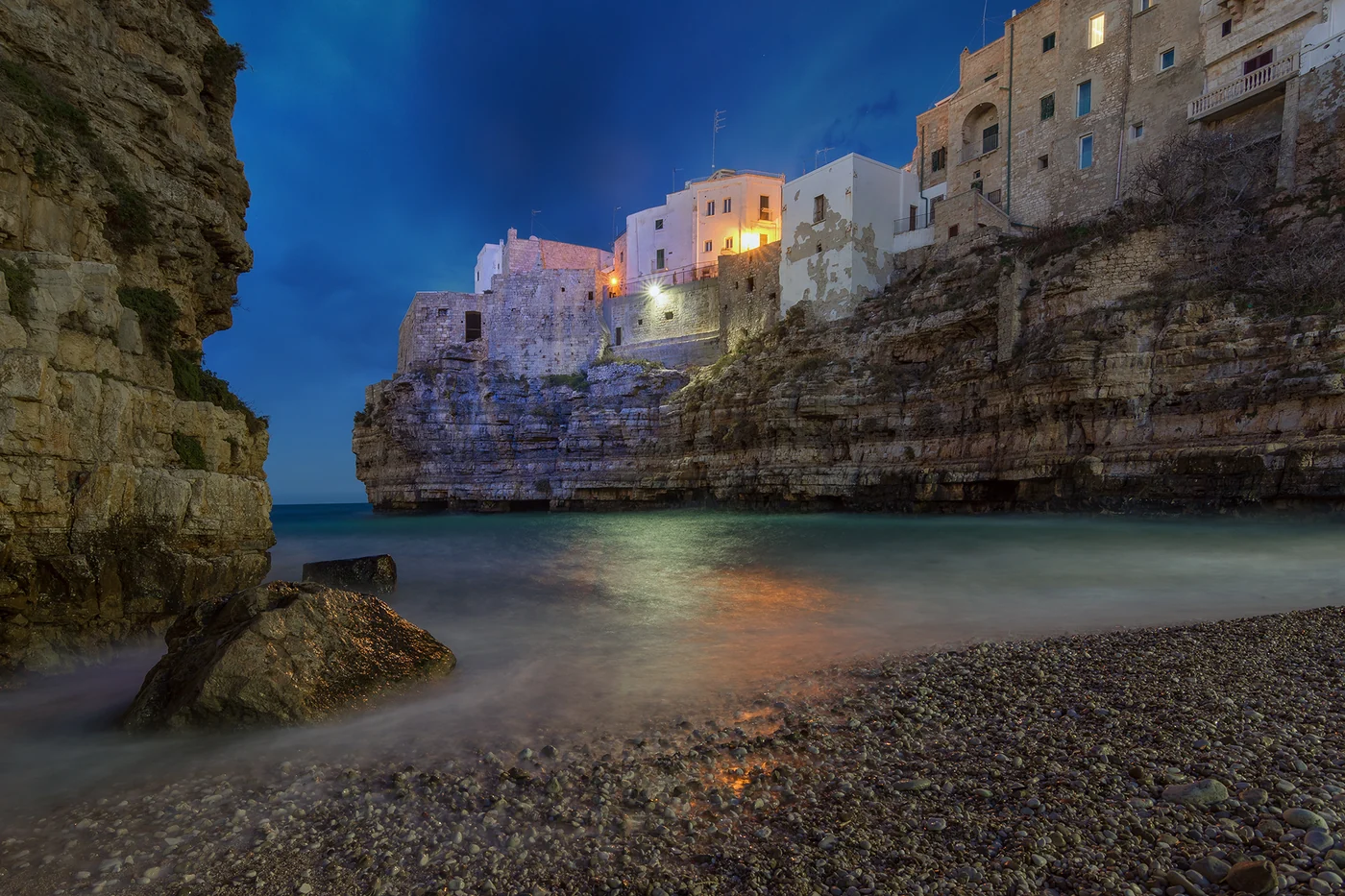
This is the picture on every Puglia mood board. The old town sits on the cliff edge, balconies hanging over the water, and Lama Monachile opens beneath it: a pebble cove between two walls of pale rock. In the evening, people line the clifftop railings to watch the light go off the sea. Swimming here is better for confident swimmers, as our Polignano article explains, along with the beaches, parking and tourist tax.
Polignano is five minutes and €1.30 by regional train from Monopoli, and that is how we would arrive: come for the cove and the cliff walk, then go back to a full-sized town to sleep. It is a place to see, not a base.
The visit
Polignano a Mare
A clifftop old town and Lama Monachile, five minutes by train from Monopoli. A place to see, not a base.
Photo by Calogero77, CC BY-SA 4.0 via Wikimedia Commons
The Salento coast: two seas, one peninsula

Photo by Travel Dude, portfolio on Unsplash
South of Lecce the land narrows to a point, and the coast becomes the main event. On the Adriatic side, the sea stacks of Torre Sant’Andrea stand in turquoise shallows, and near Roca the Grotta della Poesia, a sea cave open to the sky, fills with swimmers in summer. Otranto, a fortified port at Italy’s eastern edge, keeps its cathedral and sea walls above the harbor; from Lecce, the train takes a change at Maglie.
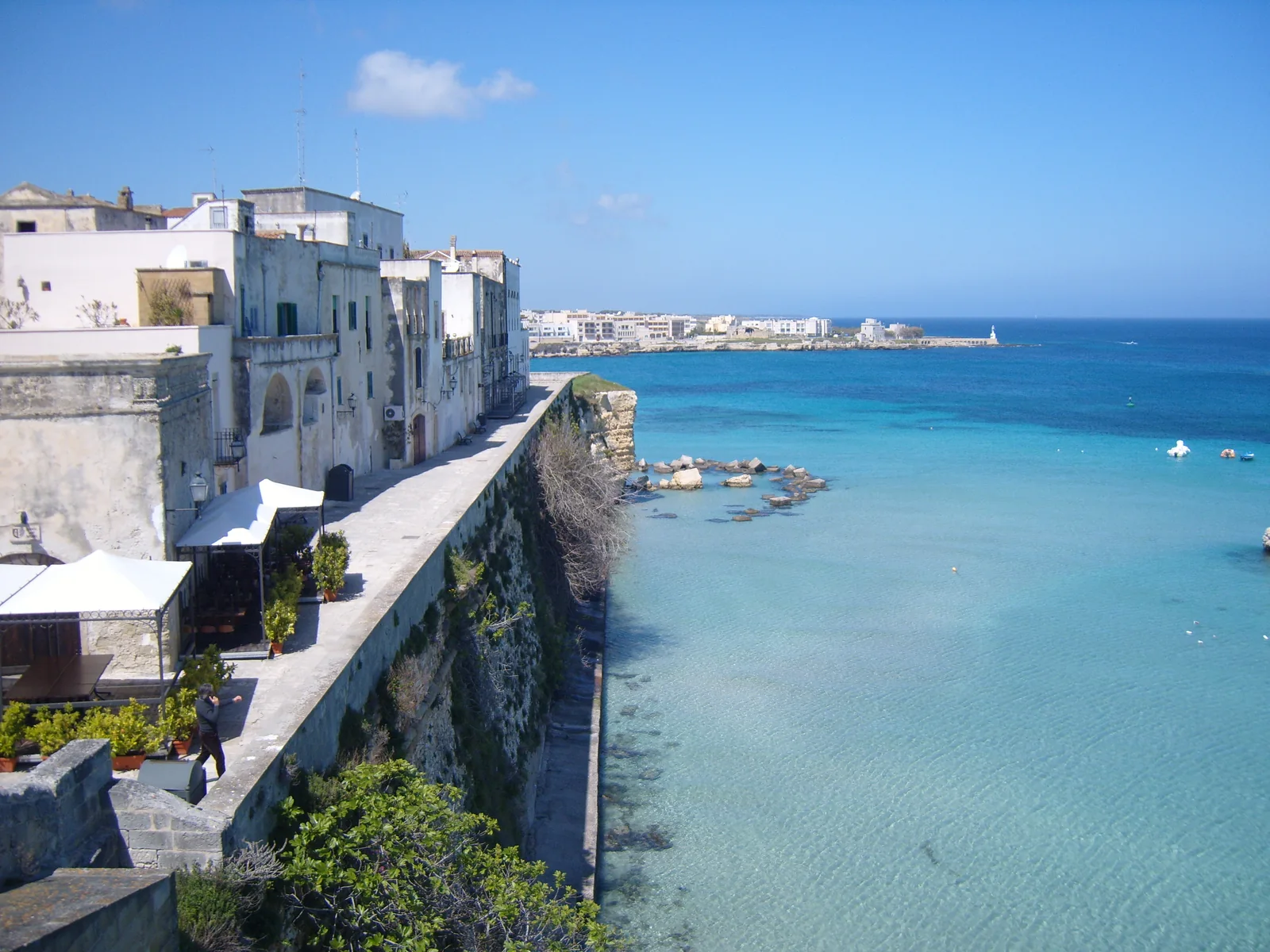
Photo by Freddyballo, CC BY-SA 3.0 via Wikimedia Commons
At the very tip, Santa Maria di Leuca marks the cape where the Adriatic and the Ionian are said to meet. From Lecce it is a direct bus of about 2 hours to 2 hours 15 minutes, or about 1 hour 20 minutes by car.

Photo by Mathilde Ro, portfolio on Unsplash
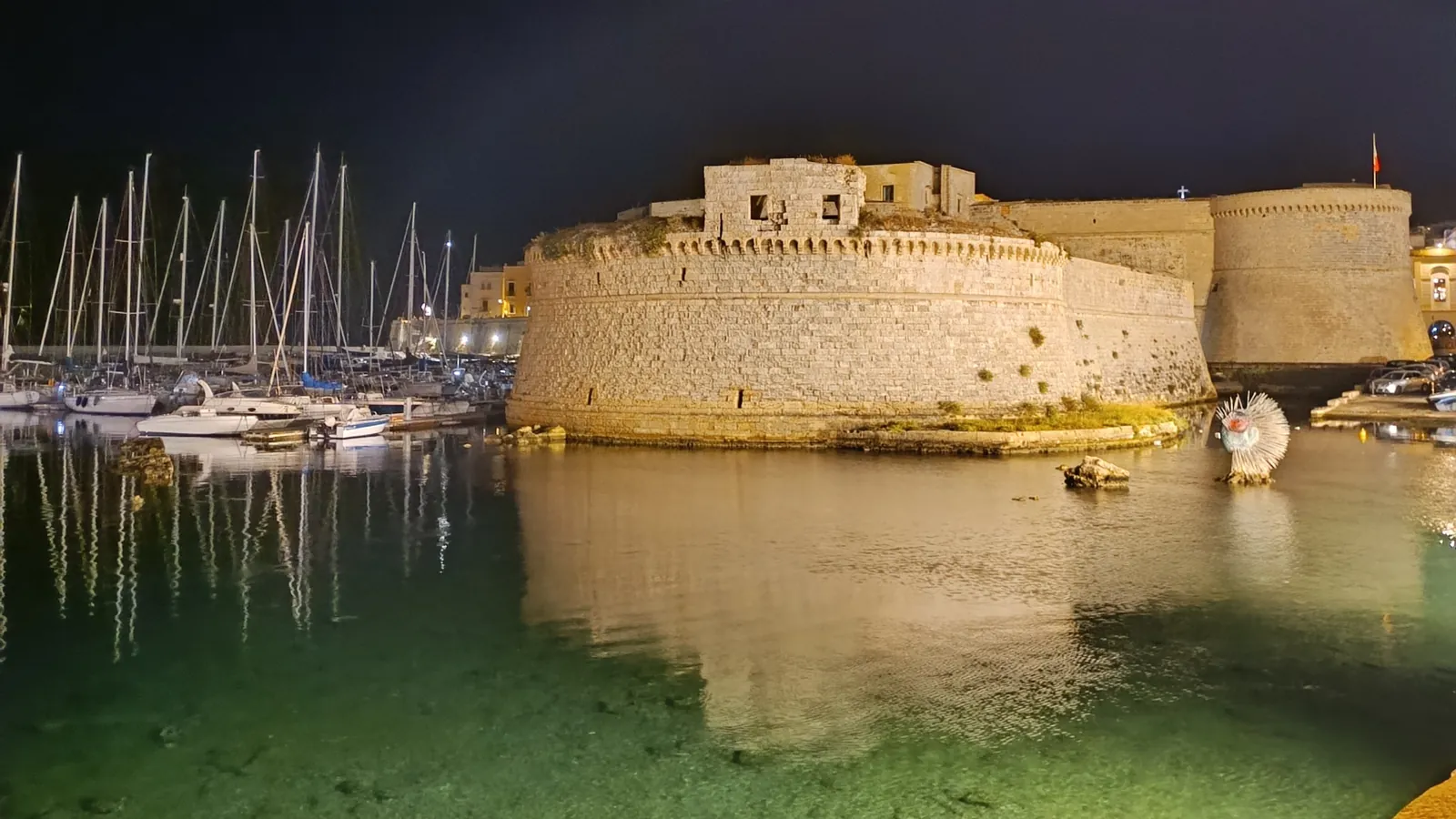
Round the cape and the Ionian side turns softer and sandier: Porto Cesareo and its marine area, the Nardò coast at Santa Maria al Bagno and Santa Caterina, and Gallipoli, an old town on an island joined to the modern town by a short bridge. From Lecce, Gallipoli is a direct weekday train of 1 hour 37 minutes to 1 hour 51 minutes, for €5.40, or about 40 minutes by car.
Trulli country: Alberobello, Locorotondo, Martina Franca
Inland from the Bari coast, the Valle d’Itria is a country of dry-stone walls, olive groves and white towns on low hills. Its signature is the trullo (plural trulli), a limestone house built without mortar under a conical stone roof. In Alberobello, the districts of Rione Monti and Aia Piccola are packed with them, and UNESCO inscribed the trulli as a World Heritage site in 1996.
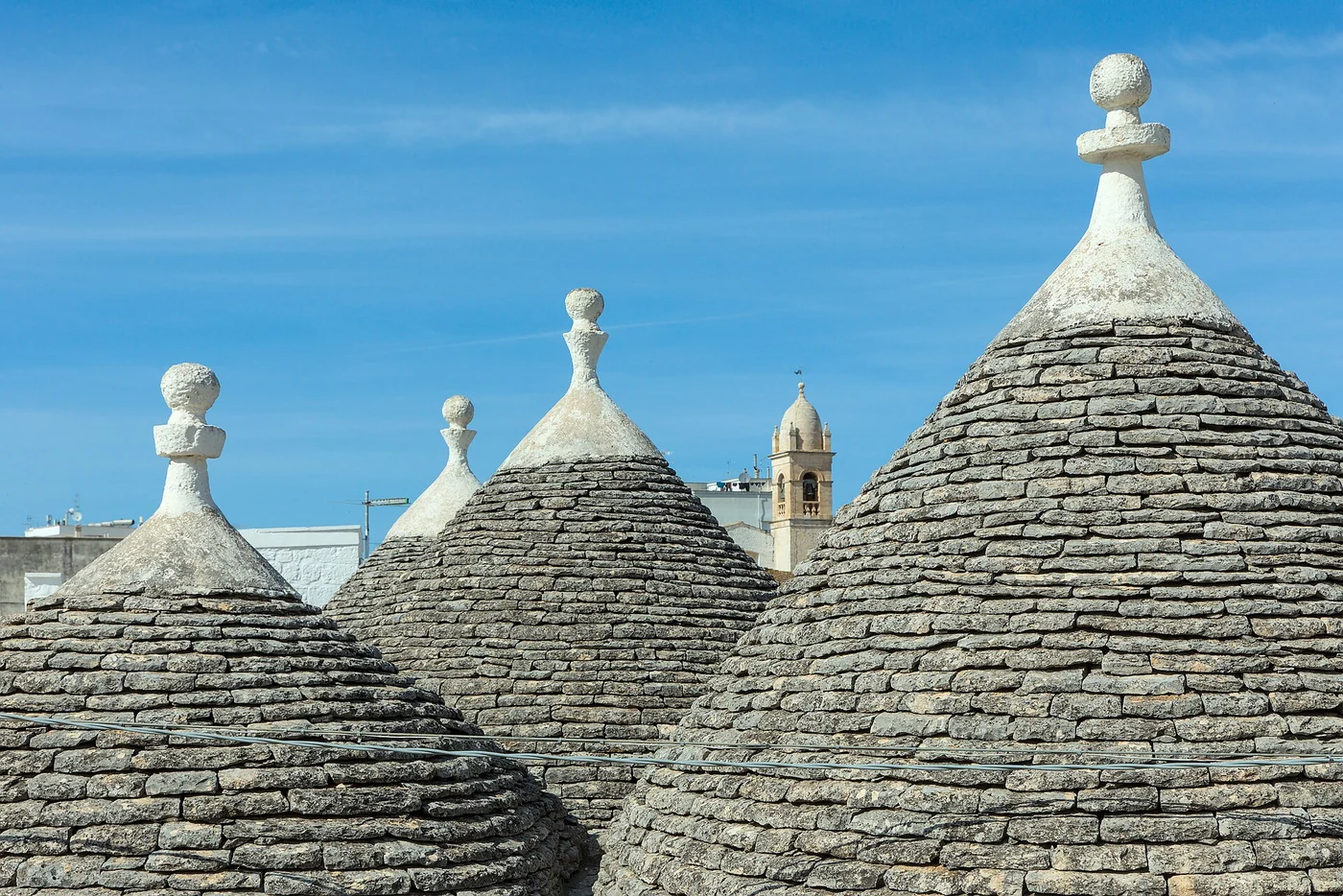
Photo by Benjamin Smith, CC BY-SA 4.0 via Wikimedia Commons
Locorotondo is the circular white town on its ridge, and the name on Locorotondo DOC, a white wine in our winery article. Martina Franca turns baroque, with palazzi and churches you can follow on our Martina Franca walking tour. Cisternino is a short hop from both. Our Valle d’Itria article covers the valley as a whole.
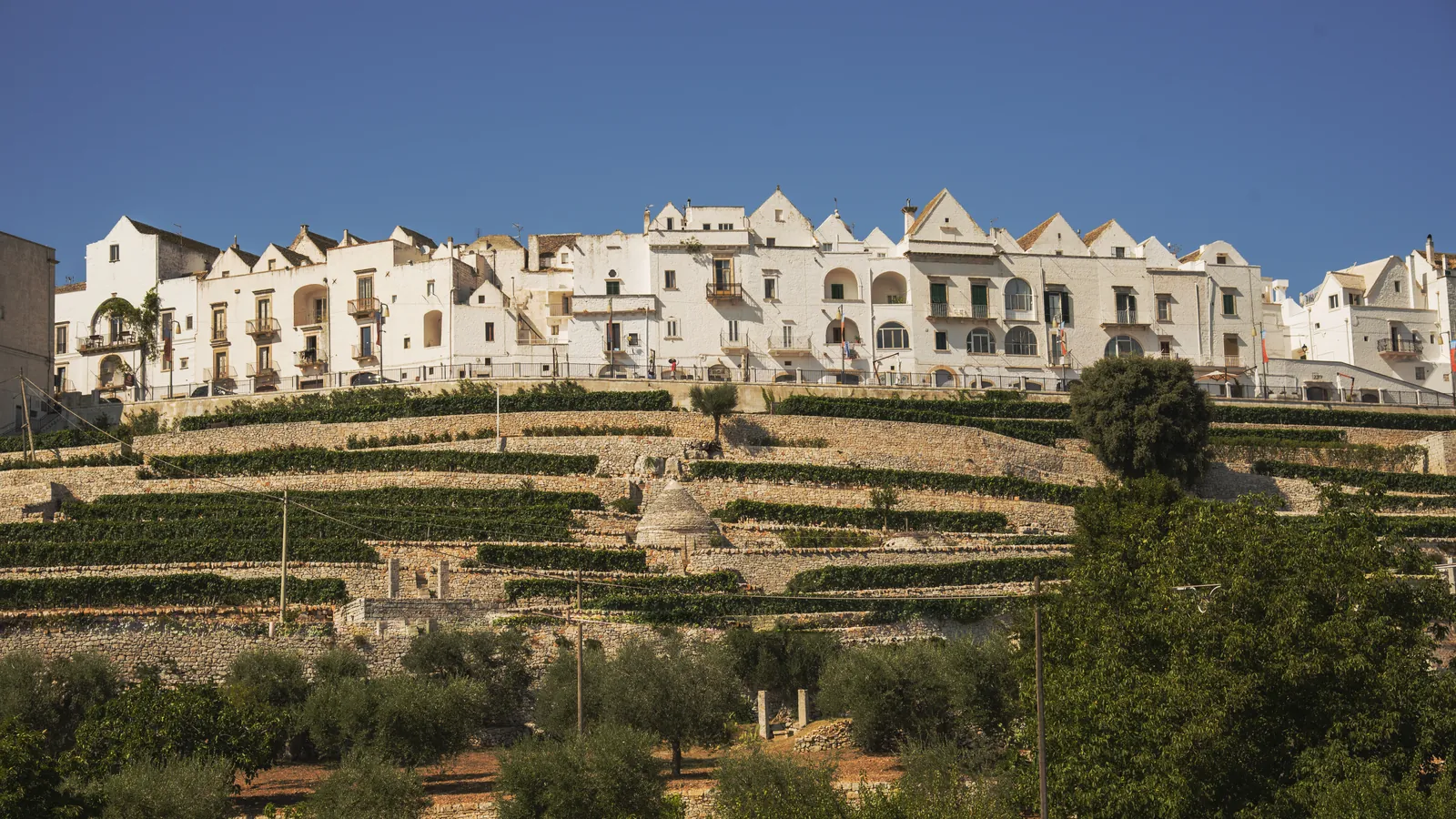
Photo by Cinzia astorino, CC BY-SA 4.0 via Wikimedia Commons
This is car country. Alberobello is about 26 minutes from Monopoli by road. By rail it takes a change: the regional train to Bari Centrale, then the Ferrovie del Sud Est line through Putignano, about 1 hour 50 minutes to 2 hours 10 minutes in all, so check the timetable before you set out.
Lecce, the baroque city
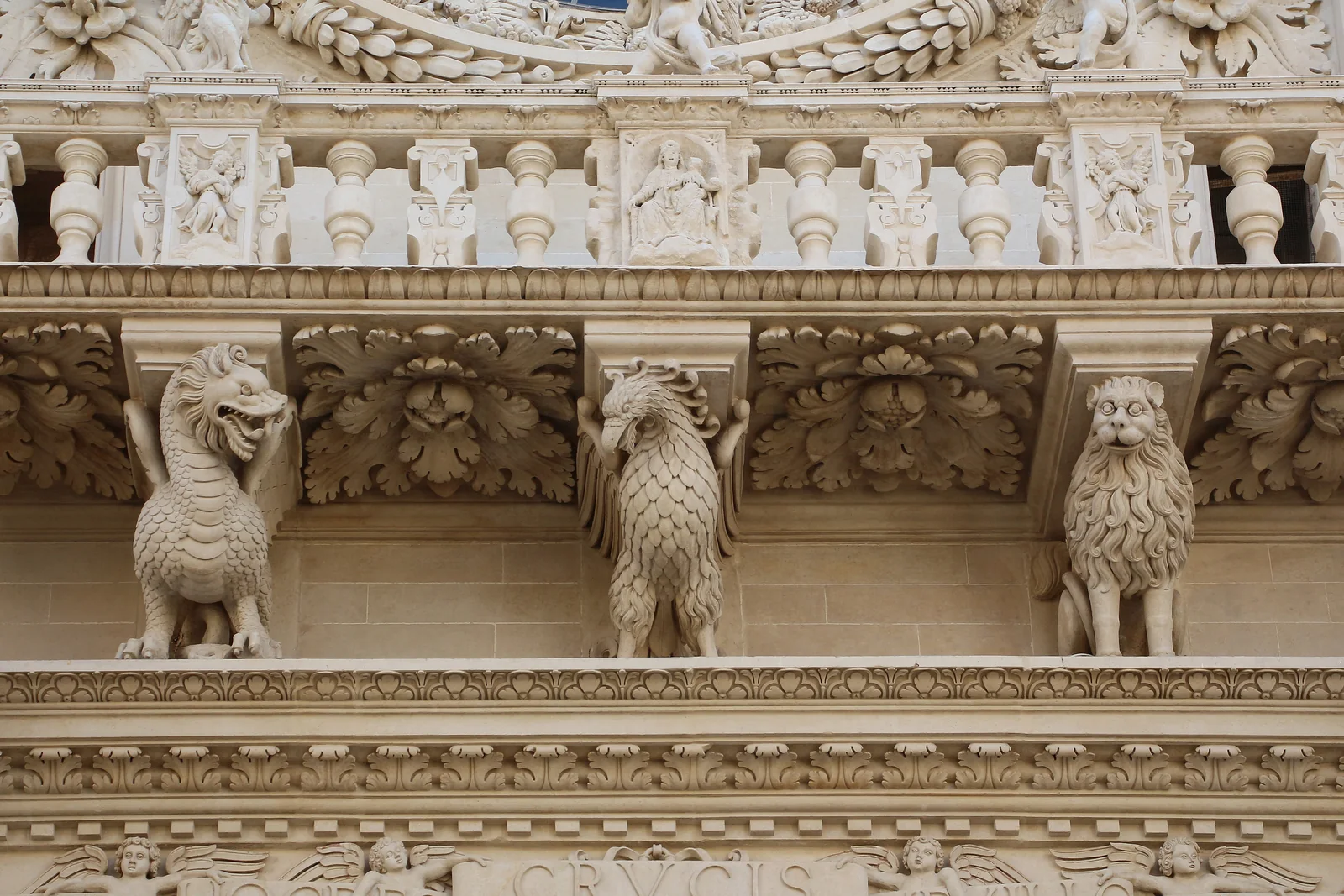
Photo by Bernard Gagnon, CC0 via Wikimedia Commons
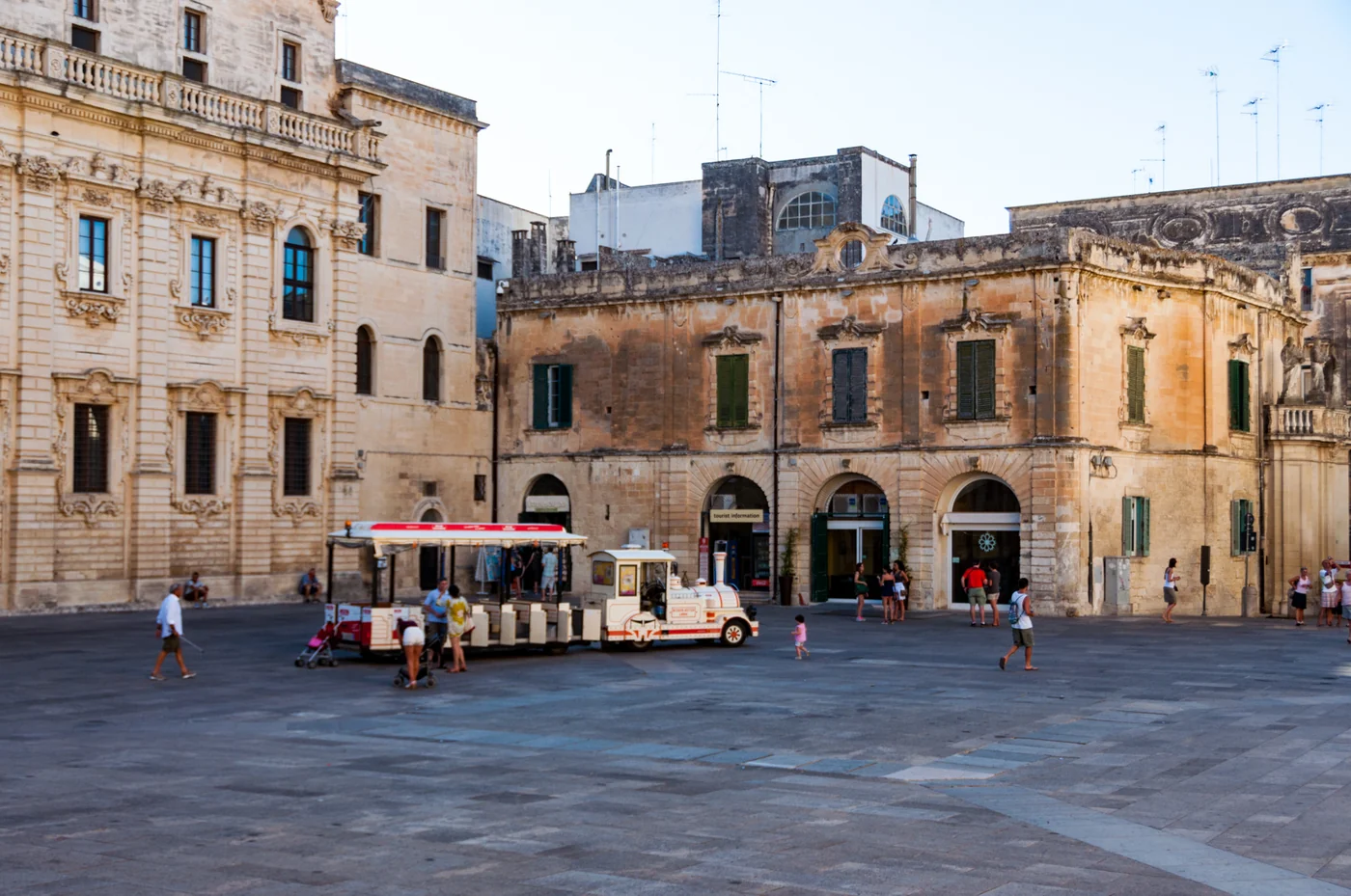
Lecce is what happens when a whole city is built from one stone. Pietra leccese, the soft local limestone, went into the carved facade of the Basilica of Santa Croce and into street after street of palazzi around it, and under Piazza Sant’Oronzo a Roman amphitheater sits half-uncovered beside the traffic. It is also a working city of 94,187 people with more than 20,000 university students, which is why it is one of our two bases. Start with our Lecce town hub and the Lecce walking tour.
Ostuni, the white town
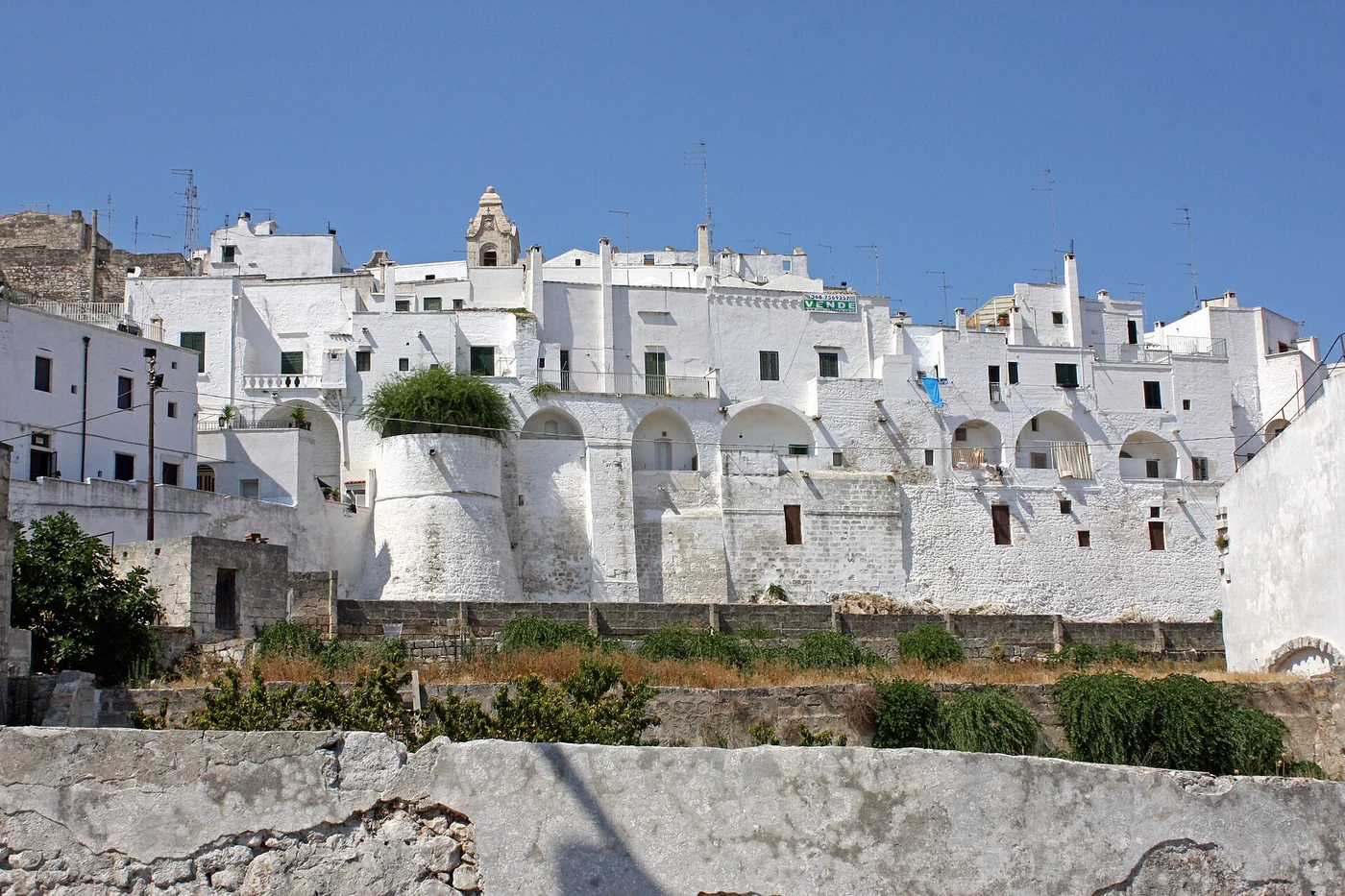
Photo by Carlo Pelagalli, CC BY-SA 3.0 via Wikimedia Commons
Whitewashed houses climb a hill above the Adriatic to a cathedral on the crest, and olive groves run down from the walls to a dune coast already in our Blue Flag article. Ostuni is on the coastal railway south of Monopoli. A full town guide is next on our list.
Bari’s old town
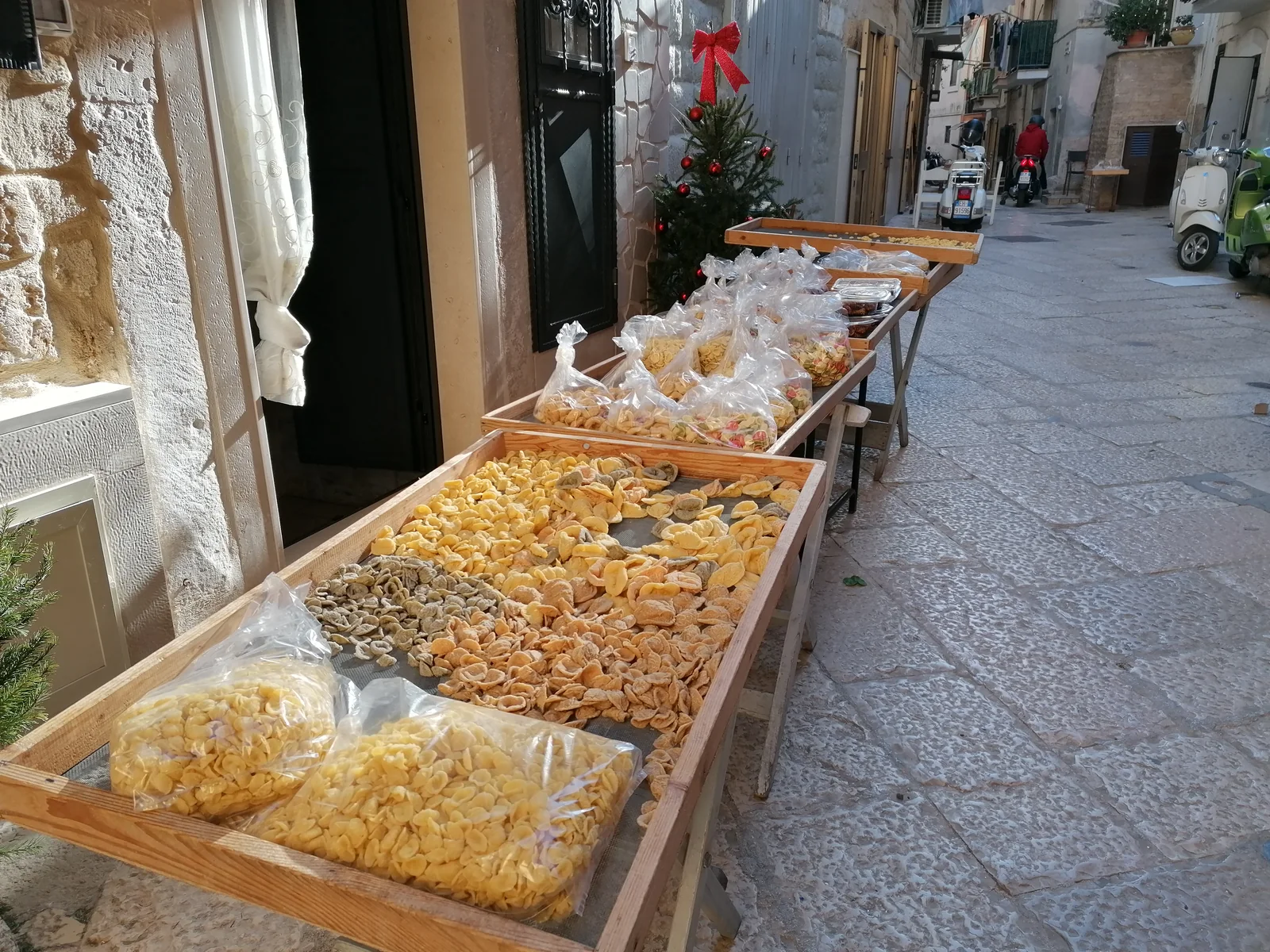
Photo by Maddy16869, CC BY-SA 4.0 via Wikimedia Commons
The regional capital is a working port with a compact old town behind the sea walls, where handmade orecchiette dry on wooden trays in the lanes. Bari Centrale is 26 to 38 minutes from Monopoli by regional train, for €4.00. A city guide is coming.
Castel del Monte and the Castellana caves
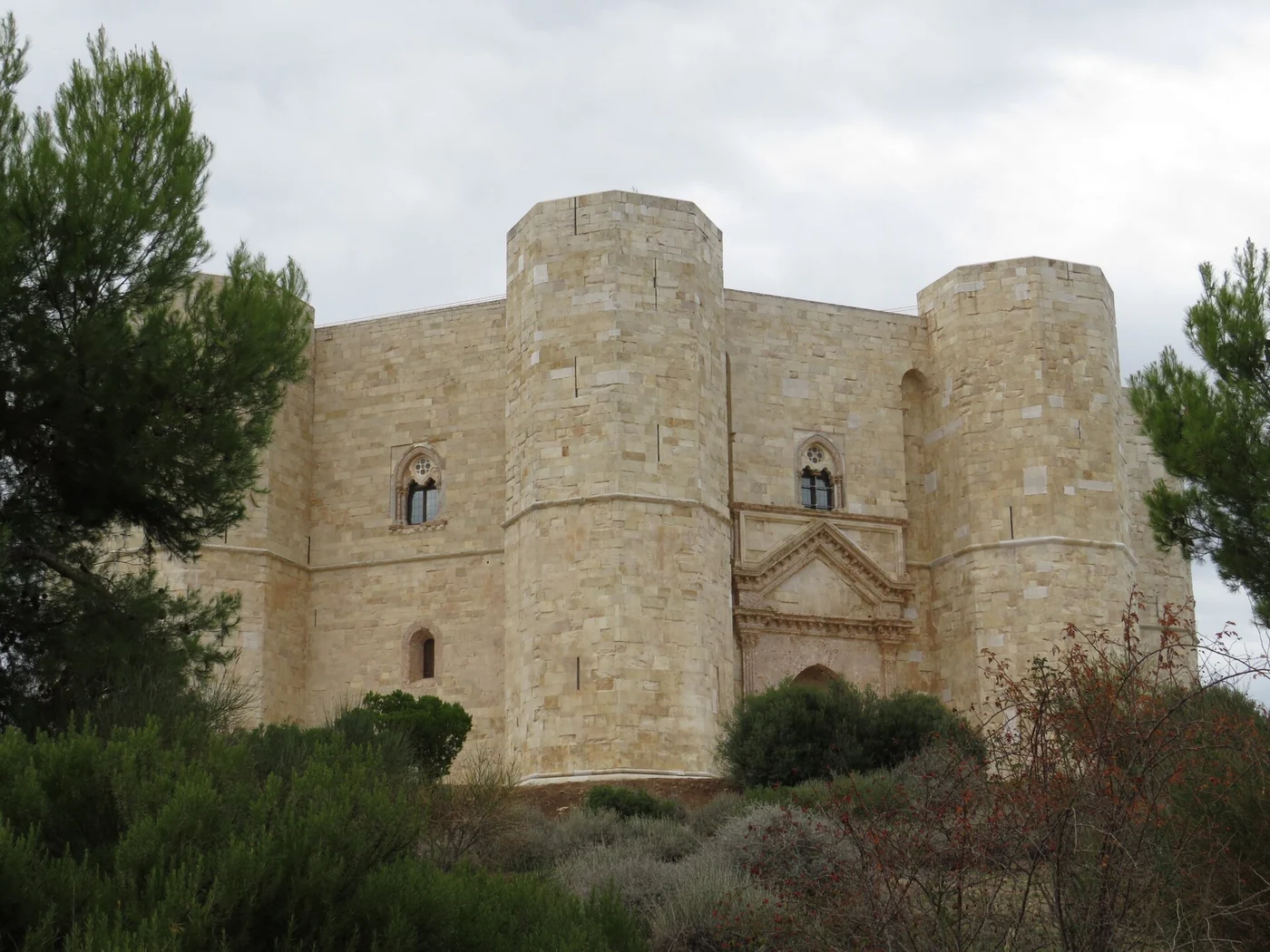
Photo by Enric, CC BY-SA 4.0 via Wikimedia Commons
On a bare hill of the Murgia plateau, in the communes of Andria and Corato, Frederick II’s octagonal Castel del Monte was completed in 1240. UNESCO inscribed it in 1996, and its geometry still feels more like a statement than a fortress. Closer to the coast, the Grotte di Castellana are a cave system inland of the Adriatic; until we write our own article, the official park site is the source for hours and tickets.
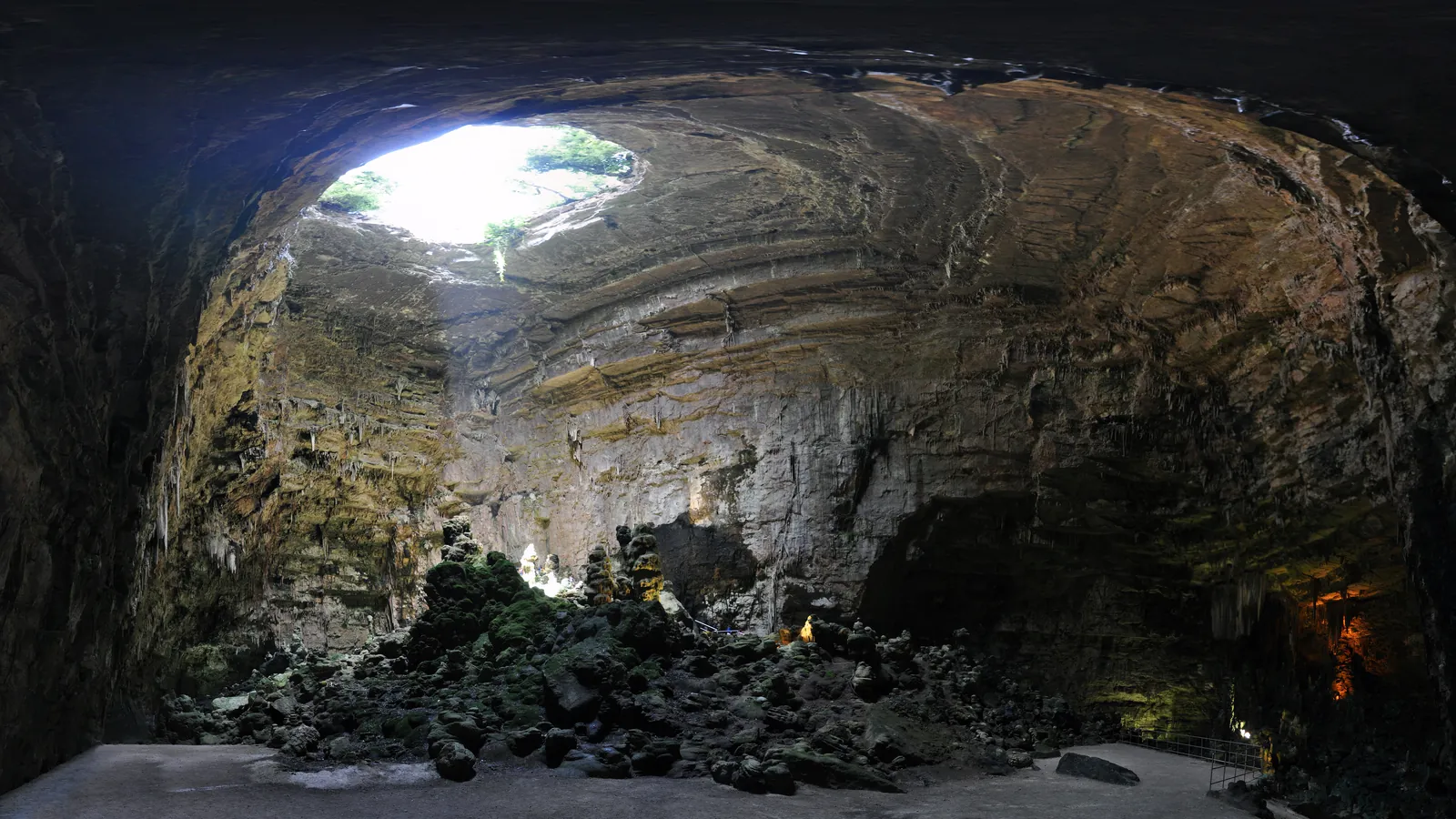
Photo by Giorgio Galeotti from Reggio Emilia, Italia, CC BY-SA 2.0 via Wikimedia Commons
Matera, the James Bond town (honorary)
Officially, Matera is in Basilicata, not Puglia. Unofficially, so many Puglia trips end up there that we have given it an honorary pass. The Sassi, its cave quarters, have been a UNESCO World Heritage site since 1993, and they are also the James Bond town of recent memory: after an opening in Norway, the pre-title sequence of No Time to Die (2021) sends Daniel Craig’s Aston Martin DB5 through Matera’s lanes and down its steps. The film presents it all as one fictional town, Civita Lucana; the production stitched Matera together with other locations, including a bridge at Gravina in Puglia, as The James Bond Dossier documents. A day-trip article, clearly labeled Basilicata, is coming.
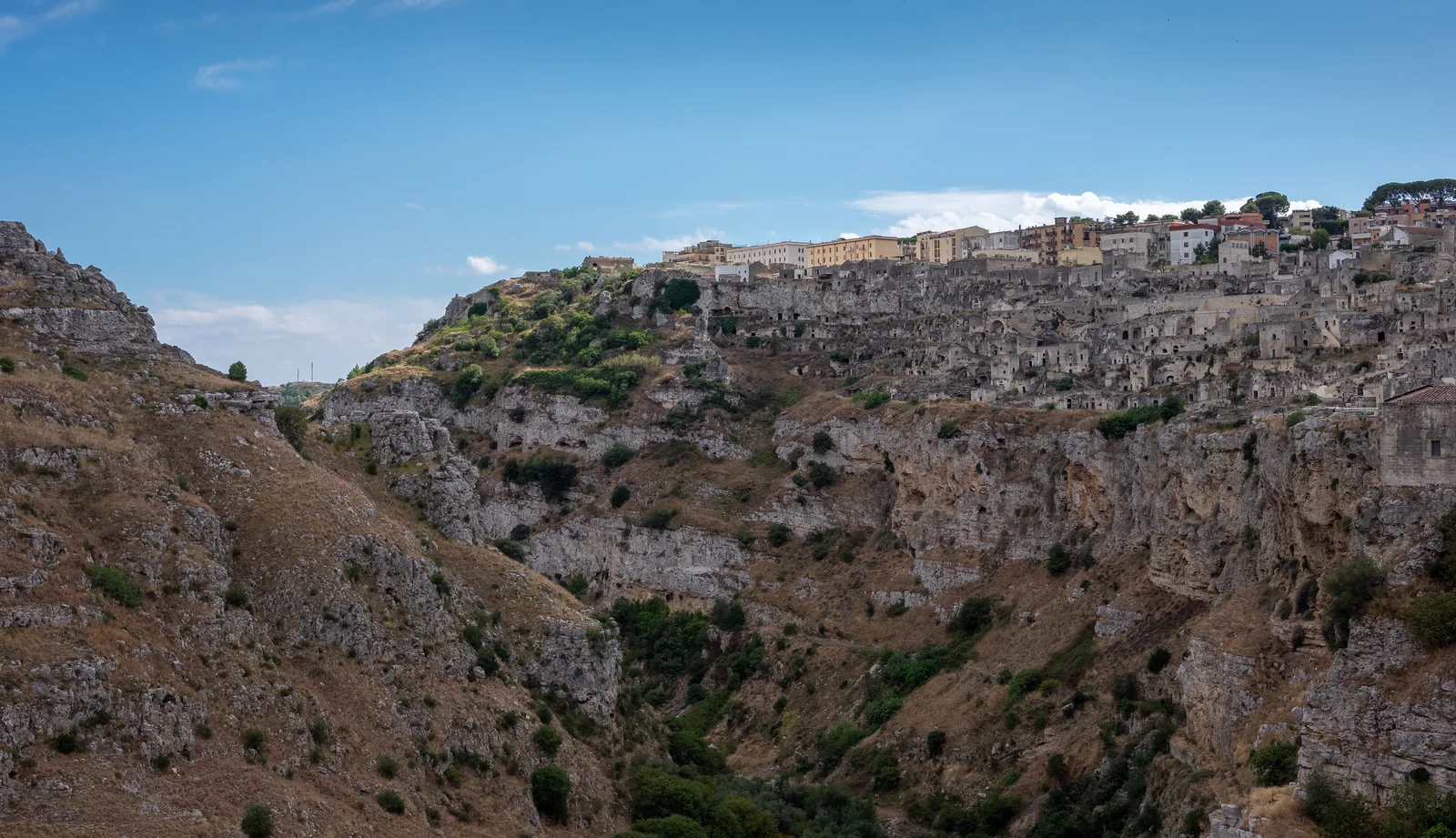
Photo by Jules Verne Times Two, CC BY-SA 4.0 via Wikimedia Commons
Also on our list
Trani, with its Romanesque cathedral on the harbor; Gravina in Puglia, a town on a ravine; Grottaglie and its potters’ quarter; the archaeological park of ancient Egnazia, near Savelletri on the Fasano coast; Galatina and its basilica of Santa Caterina d’Alessandria; Castro and the Grotta Zinzulusa sea cave; the Torre Guaceto reserve north of Brindisi; and Taranto, the Ionian city on two seas. Each will get its own guide.
Where to base yourself
Lecce for Salento, Monopoli for the Bari coast
We recommend two bases, and only two. For a first week, split it: three or four nights in each, with day trips doing the rest. Ten to 14 days can still be two bases. Fly into Bari and start in Monopoli; fly into Brindisi and start in Lecce.
Monopoli is a working port of roughly 48,000 people, about 40 kilometers south of Bari, with a walled old town on the water and four Blue Flag beaches in 2026. It sits on the main railway: Polignano is five minutes away and Bari Centrale 26 to 38 minutes, and the line runs on south toward Ostuni, Brindisi and Lecce. Trulli country is a short drive inland.
Lecce is the base for the south: a baroque center you can walk, with trains and buses fanning out to both coasts. It recorded about 1.06 million tourist nights in 2024. Brindisi airport is about 40 minutes away by car, or about 45 minutes by train plus the airport bus.
Polignano, Ostuni, Otranto, Gallipoli and Leuca are often sold as bases. For a first trip we would visit every one of them and sleep in none: two bases keep you on the railway, in full-sized towns with year-round life, and spare you a check-out every other morning. Without a car, much of the week works by train and bus, though Sunday service is thinner. With a car, add a countryside masseria or a slower look at the Valle d’Itria.

A home base
Lecce as a base for Salento
The city base for the south: trains, buses, beaches, parking and costs, in 2026 figures.
Photo by Laura Massarelli, CC BY-SA 4.0 via Wikimedia Commons

A home base
Monopoli as a base in Puglia
The Bari-coast and trulli-country base: trains, beaches, parking and costs.
Photo by Luca Dimola, portfolio on Unsplash
The region and its past
A long peninsula, two seas, and the empires that passed through
Puglia runs down the heel of Italy with the Adriatic along its eastern edge and the Ionian along the west of Salento. Salento is the south, beginning around what Treccani calls the Soglia Messapica, the Messapian threshold between Taranto and Brindisi. The Valle d’Itria is the trulli country, across parts of Bari, Brindisi and Taranto provinces. Bari and the Adriatic coast carry the main railway and the run of clifftop and harbor towns south to Ostuni. The Murgia is the limestone plateau behind them, where Castel del Monte stands. Taranto and the Ionian side face the other sea, down to Porto Cesareo and the Nardò coast.
The past here is long, and we only set down what we can source. Treccani’s entry on the region traces the arc: in 1071, with Robert Guiscard, all of Puglia entered the Norman monarchy. Under Frederick II (1220-1250), cathedrals and fortresses went up and the ports opened further to Venetian and Genoese shipping; Castel del Monte is his most famous building. The 1529 peace between the French and the Spanish brought almost all of Puglia under Spanish rule, and Lecce’s baroque, the style most travelers meet first, came later still.
None of it was preserved as a set. These are provincial towns with work to do, and that lived-in quality is a large part of their pull. The map below marks the places we have already written, and those coming next.
Find your town
From Bari down to Santa Maria di Leuca at the tip of Salento. Tap a town to open our guide.
Our favorite towns
Salento
- Lecce→
- Otrantoguide coming
- Gallipoliguide coming
- Porto Cesareoguide coming
- Torre dell'Orsoguide coming
Bari Coast
Brindisi & Ostuni
- Ostuniguide coming
Itria Valley
- Martina Franca→
- Alberobelloguide coming
Beaches
Rock platforms on the Adriatic, long sand on the Ionian
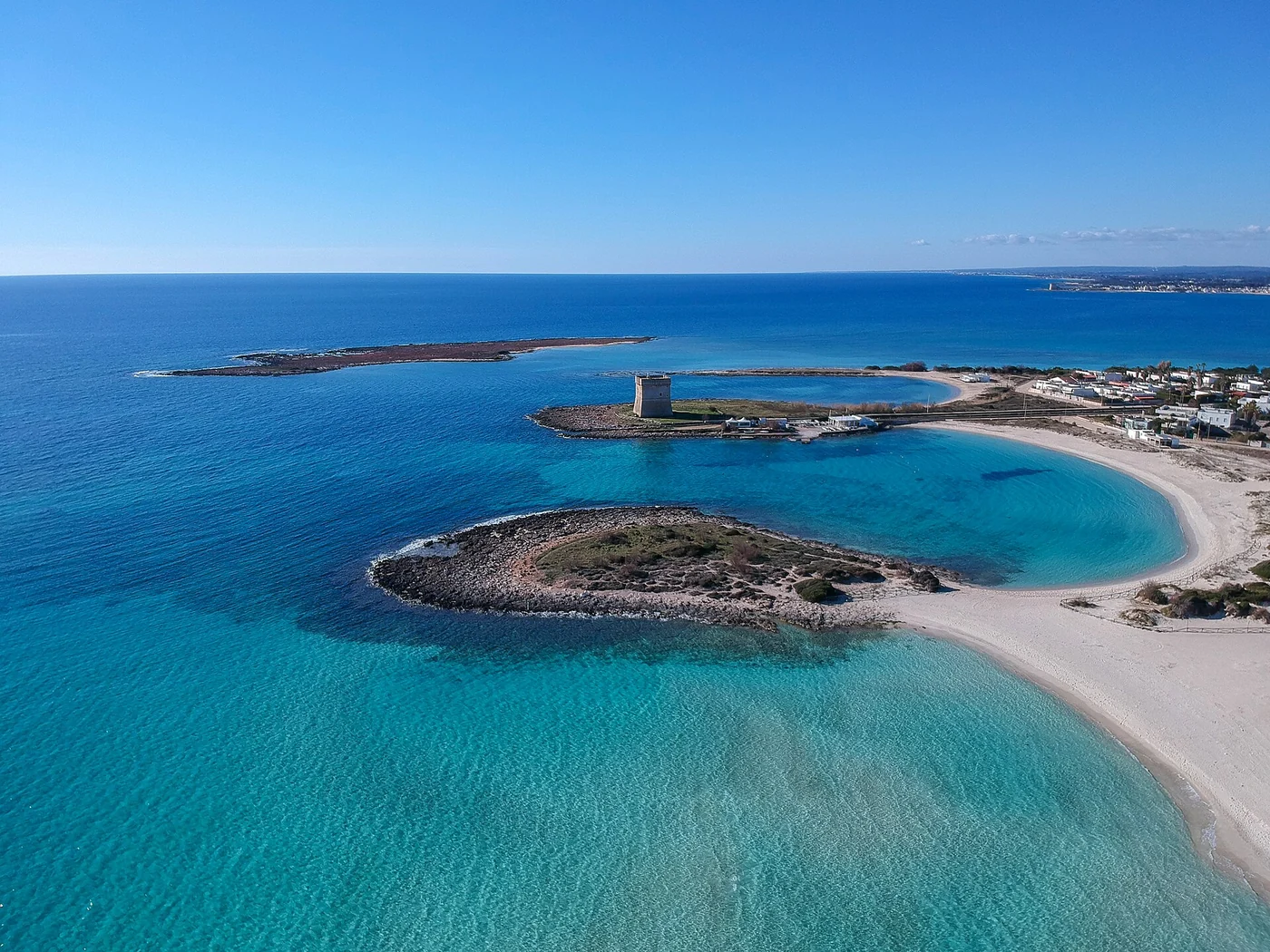
Photo by Paolo Damiano Dolce, CC BY-SA 4.0 via Wikimedia Commons
Our 2026 Blue Flag article is the place to start: 22 awarded towns on the Puglia coast outside Foggia province, from FEE Italia. From that list and our town guides, a first trip might take in Monopoli’s four flags, the cove at Polignano, Ostuni’s dune coast, Porto Cesareo, Gallipoli’s southern shore, Torre dell’Orso, Santa Maria al Bagno and Santa Caterina on the Nardò coast, and San Cataldo, Lecce’s nearest beach, which you can reach on the city bus with our Lecce beach-bus article.
Some stretches have a lido, a private beach club with loungers and umbrellas to rent, and some are free. Expect rock platforms and coves on much of the Adriatic, and longer sand on the Ionian.
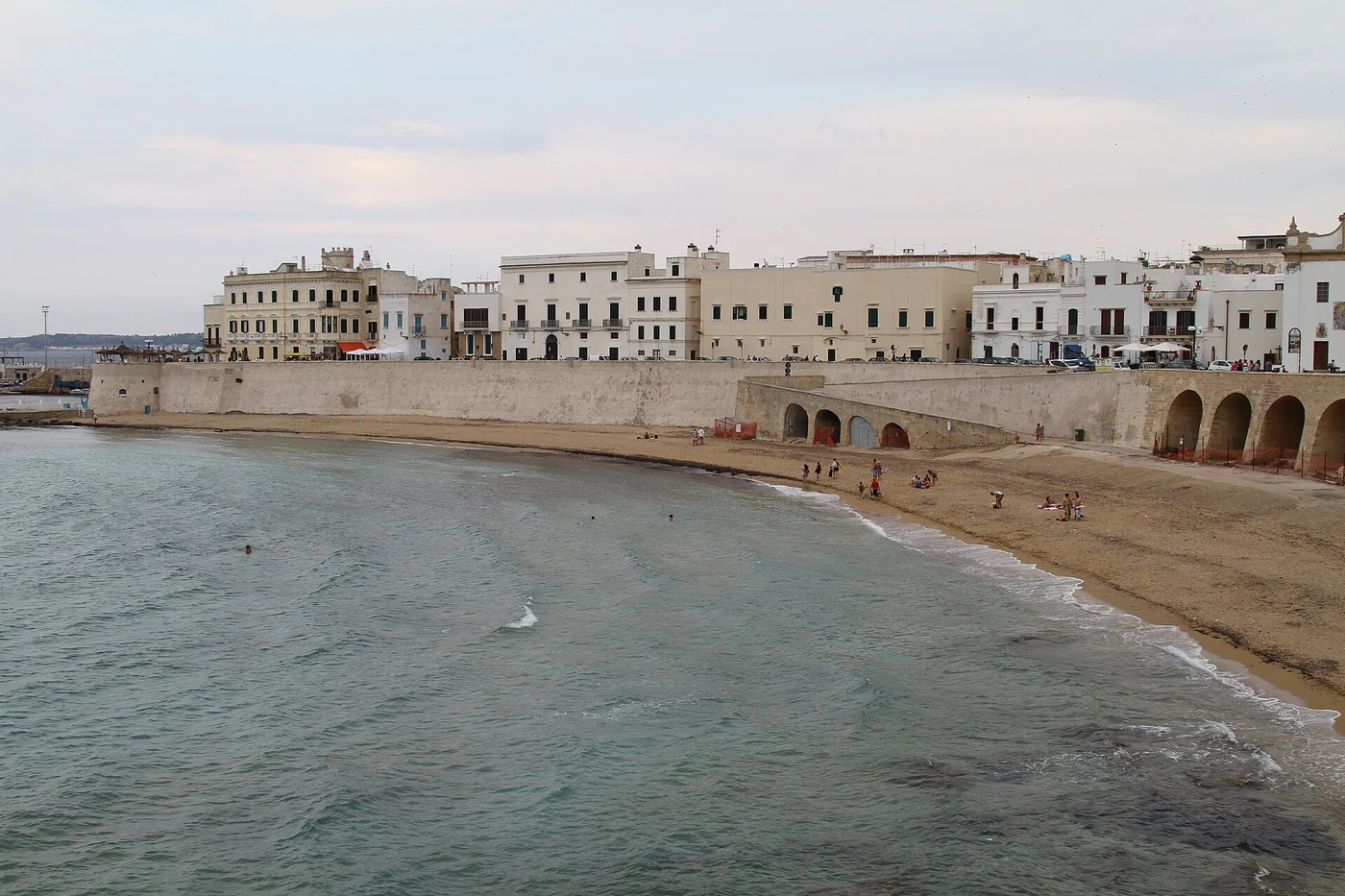
Photo by Carlo Pelagalli, CC BY-SA 3.0 via Wikimedia Commons
Food, wine and masserie
Durum wheat, new oil, and farmhouses built like small forts
Puglia’s table is close to the ground: durum wheat, olive oil, and seafood on the coast. Our Puglia food article explains what to eat and where it comes from; in Lecce, start with how to eat like a local or, for a big night, our fine dining article.
The wines to know are Primitivo di Manduria, Negroamaro and Salice Salentino, Locorotondo DOC and the Castel del Monte hills; Wine tasting in Puglia covers winery visits and what a tasting costs in 2026. In autumn, the new oil arrives, as our olive harvest article explains.
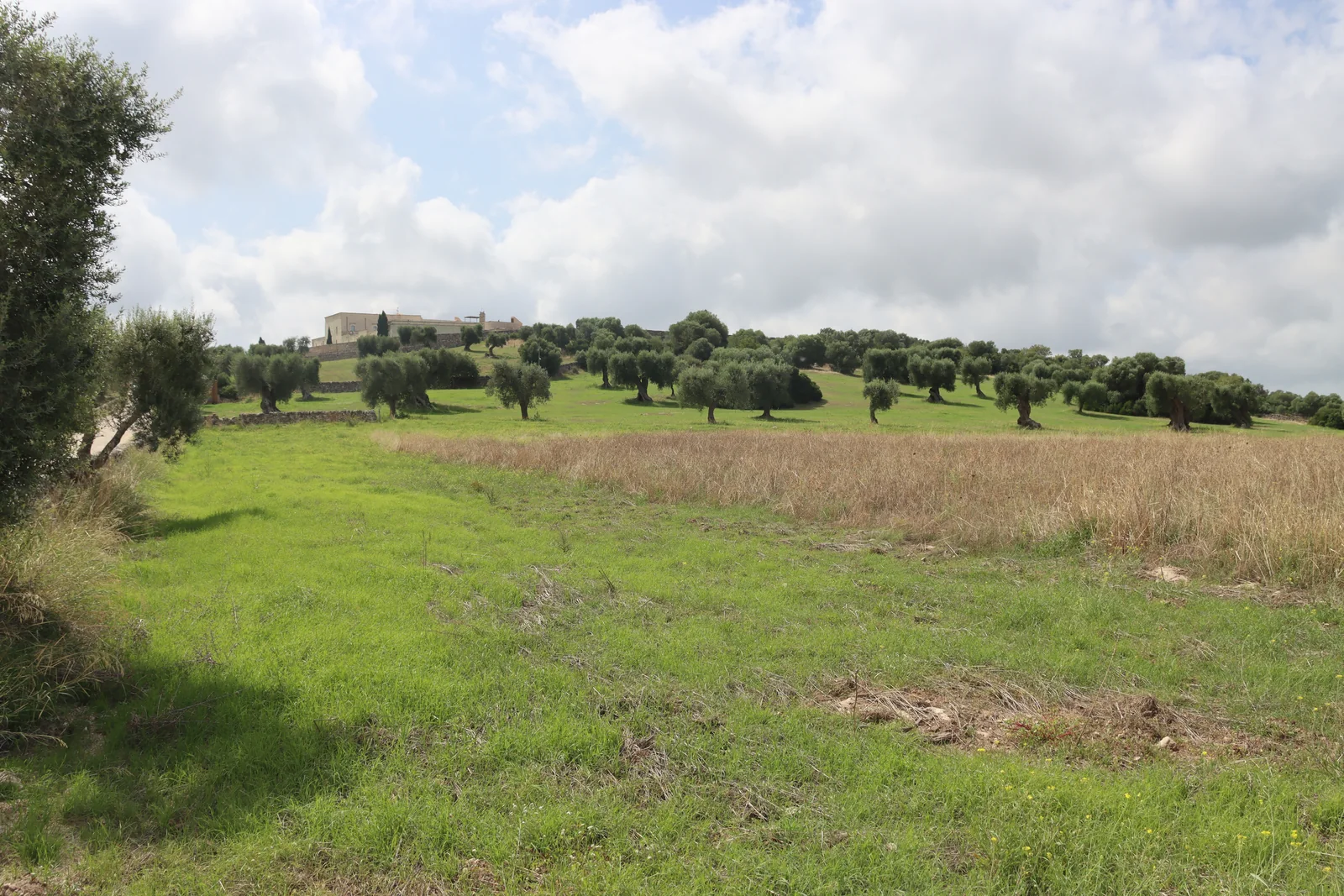
Photo by FrDr, CC BY-SA 4.0 via Wikimedia Commons
A masseria is a fortified farmhouse of the kind still scattered through the Valle d’Itria and Salento, and a night in one is a different trip from an old-town stay: quieter, greener, and close to impossible without a car. A trullo stay is the more particular version of the same idea. We do not publish a property roundup on this page; for Lecce, our unique places to stay is the city piece, and if you are coming to marry, see our wedding venues article.
What it costs, compared with Rome, Florence and Amalfi
The tourist tax as a yardstick, from each town’s own rules
Puglia is often called great value next to Italy’s headline destinations. We would rather show a number than repeat a slogan, and the cleanest number we can compare across towns is the imposta di soggiorno (tourist tax), because each comune publishes it in an official resolution. Here is what a guest in a four-star hotel pays, per person per night, in 2026.
| Town | Four-star hotel, per person per night | Nights charged |
|---|---|---|
| Rome | €7.50 | Up to 10 |
| Florence | €7.00 | Up to 7 in a row |
| Amalfi | €4.00 | Charged 1 April to 2 November |
| Lecce | €4.50 April-October, €3.00 November-March | Up to 5 in a row |
| Monopoli | €4.00 | All year |
Puglia Everyday analysis: for two people spending seven nights in a four-star hotel, the tax comes to €105 in Rome and €98 in Florence, against €45 in Lecce in high season, where only the first five nights are charged. Amalfi’s hotel rate is close to Puglia’s, so on that coast the difference lies elsewhere, and we have not found an official room-price series we trust enough to publish.
The everyday numbers help too: €1.30 for the train from Monopoli to Polignano, €4.00 to Bari Centrale, €5.40 from Lecce to Gallipoli. We will not invent a daily budget. Our guide to Lecce, the Florence of the South makes the city comparison in stone rather than euros.
Why everyone is talking about Puglia
Growth, an old comparison, and a few famous arrivals
Puglia is no longer a secret, and we will not pretend otherwise. In official accommodation, ISTAT recorded 17,894,361 overnight stays in Puglia in 2024: 11,862,805 by Italian travelers and 6,031,556 by visitors from abroad. That was 3.8 percent of Italy’s total, and about 1.1 million more nights than in 2023, a rise of 6.4 percent against 4.2 percent for Italy as a whole. Lazio (13.2 percent), Sardegna (9.9 percent) and Lombardia (8.0 percent) grew faster, but among the six regions ISTAT groups as the mainland South, Puglia was the strongest, ahead of Abruzzo (5.5 percent) and Campania (3.3 percent).
The longer view is more striking. ISTAT’s 2025 statistical yearbook notes that foreign overnight stays in Puglia were 57.0 percent higher in 2024 than in 2019, a figure it places next to Lazio’s 42.6 percent. A second official series, from Pugliapromozione and the Regione Puglia tourism observatory, includes tourist rentals, so its totals run higher and should not be mixed with ISTAT’s: about 5.9 million arrivals and more than 20.7 million nights in 2024, up 10.6 and 9.7 percent, with foreign arrivals up 22.6 percent and foreign nights up 21.9 percent. US arrivals and nights both rose about 21 percent (the BIT 2025 table gives plus 20.4 percent for arrivals and plus 21.6 percent for nights), and international arrivals roughly tripled between 2015 and 2024, from about 730,000 to 2.3 million. ISTAT also counts American and French visitors among the main foreign markets in Puglia, Sicilia and Campania.
Writers have been asking whether Puglia is “the new Tuscany” since at least 2004, when The Guardian ran Amy Raphael’s “Is Puglia the new Tuscany?” Three years later, in “Why this will never be the new Tuscany,” Alex Gorton wrote that “as all avid readers of weekend travel sections know, Puglia is apparently the ‘new Tuscany,'” then argued that it is “very much its own place.” We side with Gorton.
The famous arrivals are part of the story. In 2007, after a visit to the Salento International Film Festival, Helen Mirren and Taylor Hackford were reported to have bought Masseria Matine, a 16th-century farmhouse near Tiggiano. On 19 October 2012, Justin Timberlake and Jessica Biel married at Borgo Egnazia, in Savelletri di Fasano, and the same resort hosted the 50th G7 summit from 13 to 15 June 2024. In August 2017, Madonna marked her 59th birthday in Puglia by dancing the pizzica, the circle dance of Salento.
Plan the trip
When to go, how to arrive, and whether to drive
When to go. For most first trips, May, June or September, as our month-by-month article explains. The sea is warm enough from June; July and August bring the heat and the crowds. Winter is a quieter, different Puglia, with more open than many expect (see Puglia in winter), and December has its own map in Christmas markets in Puglia. For a sense of the climate, compare Lecce’s weather with major US cities.
Getting there. Most visitors fly into Bari Karol Wojtyła (BRI) or Brindisi-Salento (BDS); the official tourism site, viaggiareinpuglia.it, and Aeroporti di Puglia list current routes. The main railway runs Bari-Brindisi-Lecce, with Polignano and Monopoli on the coastal line, and Ferrovie del Sud Est covers much of Salento from Lecce. Recheck fares and times on the day you travel.
Driving. Our article on driving on a US or UK license covers the rules. Lecce’s historic center is a limited-traffic zone, the ZTL, explained in our Lecce ZTL article, and Monopoli and Polignano have old-town limits of their own. If a camera ticket follows you home, here is how to pay a traffic ticket as a foreigner.
If you are American. Most US visitors enter Italy as tourists under the Schengen short-stay rules, currently 90 days in any 180-day period; recheck those rules, and any ETIAS requirement in force when you fly, on official Foreign Ministry and EU pages before you book. Yes, you can drink the tap water from the public supply, with caveats, and our article on bringing food home covers what US customs will allow.
Every article we have written for your trip
All of it, in one place
FAQ
Where should I base myself in Puglia?
In Lecce for Salento and in Monopoli for the Bari coast and the trulli country, ideally both. Polignano a Mare is a visit, five minutes by train from Monopoli, not a base. See Where to base yourself.
How many days do I need?
About a week for a first trip, split between the two bases with three or four nights in each. Ten to 14 days can still be two bases.
Do I need a car?
Not for the two-base trip, if you can live with thinner Sunday trains. A car helps for a masseria stay and for the Valle d’Itria.
Which airport should I fly into?
Bari (BRI) for a first stay in Monopoli, Brindisi (BDS) for Lecce.
When is the best time to go?
May, June or September for most trips. July and August are hotter and busier; winter is quieter and different.
Is Matera in Puglia?
No, it is in Basilicata, though so many Puglia trips include it that we treat it as an honorary stop. Much of the Italian pre-title sequence of No Time to Die was filmed in its Sassi.
Sources
Official and contemporaneous sources opened or re-opened on 14 November 2026, Europe/Rome, and saved in this project’s source pack: ISTAT, Movimento dei clienti negli esercizi ricettivi, 2024 (Statistica Today), for overnight stays by region; ISTAT, Annuario Statistico Italiano 2025, tourism chapter, for foreign nights in 2024 versus 2019; ISTAT, permanent census focus and territorial release, Puglia population at 31 December 2024 (3,877,395); Pugliapromozione / Regione Puglia Osservatorio, “I trend del Turismo. Anno 2024,” and the BIT 2025 report, for the rental-inclusive series, the US +21 percent rounded figure, and the 2015-2024 international arrivals; ISTAT census communicato; Regione Puglia trend page; UNESCO, Trulli of Alberobello; UNESCO, Castel del Monte; UNESCO, Sassi of Matera; Treccani, “Puglia,” for the 1071 Norman entry, Frederick II (1220-1250), and the 1529 Spanish settlement; The Guardian, Amy Raphael, 27 June 2004; The Guardian, Alex Gorton, 20 May 2007; El País, 31 March 2007, and contemporaneous Hello, Metro and La Stampa reports, for the Mirren-Hackford purchase; People and BBC News, 22 October 2012, for the 19 October 2012 Timberlake-Biel wedding at Borgo Egnazia, Savelletri di Fasano; the Council of the EU meeting page for the 50th G7 summit, 13-15 June 2024, at Borgo Egnazia (the HTML could not be retrieved from this box on 14 November 2026; Reuters covered the opening on 13 June 2024); ANSA English, 17 August 2017, for Madonna’s 59th birthday and the pizzica; The James Bond Dossier, Italy locations for No Time to Die, and 007.com’s Matera materials, for the film geography; viaggiareinpuglia.it, Come arrivare. Train fares, tourist tax, population and Blue Flag counts used from our already-sourced live articles are cited in place. Puglia Everyday research.
We did not use a combined Aeroporti di Puglia passenger total that includes Foggia airport. We did not mix the ISTAT and Pugliapromozione night counts into one figure. We did not call Puglia Italy’s fastest-growing tourism region. We did not describe Puglia, in our own voice, as “the new Tuscany,” or as a secret. Celebrity items we could not verify to our standard, including reports about Meryl Streep, were left out. A 2021 Madonna birthday at Borgo Egnazia, reported by Vanity Fair Italia, was not re-checked to publication standard on this date and is not used here.
Added 15 November 2026, Europe/Rome, for the tourist-tax comparison: Roma Capitale, contributo di soggiorno tariffs from 1 October 2023 (Giunta resolution 255/2023: four-star hotels €7.50, up to 10 nights); Comune di Firenze, Giunta resolution 535/2024 (four-star hotels €7.00) and the Florence tourist-tax regulation in force from 1 November 2026 (up to 7 consecutive nights); Comune di Amalfi, Giunta resolution 24/2022 (four-star hotels €4, charged 1 April to 2 November); Comune di Lecce, imposta di soggiorno, rates from 1 April 2026 under Giunta resolution 46/2026 (four-star hotels €4.50 April-October, €3.00 November-March, up to 5 consecutive nights); Comune di Monopoli, imposta di soggiorno, as reported in our Monopoli article (€4 in four- and five-star hotels, all year). The Alberobello rail connection from Monopoli (via Bari Centrale and the Ferrovie del Sud Est line through Putignano, about 1 hour 50 minutes to 2 hours 10 minutes) is from our Monopoli article, updated 15 November 2026 from the FS Sud Est and Trenitalia timetables. The seven-night totals are Puglia Everyday analysis.